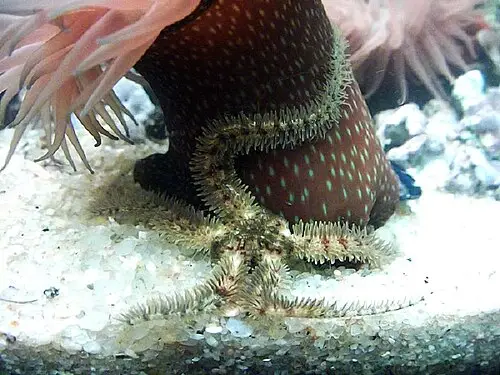
 📸 Photo
Photo: PedroPVZ · CC BY-SA 3.0 · Wikimedia Commons Source
Common brittlestar
Ophiothrix fragilis (Common brittlestar · Common brittlestar)
Not Evaluated (NE) on the IUCN Red List yet.
💡 Everyday Comparisons for Size, Mass & Speed
- 💡 Its maximum disc diameter of 20 mm is smaller than the diameter of a Korean 500-won coin (26.5 mm) (Comparison).
- 💡 From 340 to over 2,000 individuals gather in 1 m², and 1 m² is about the area of a single yoga mat (about 1.1 m²) (ADW behavior) (Comparison).
Reference standards: coach bus ~12 m, mid-size car ~4.9 m, compact car ~1 t, basketball hoop 3.05 m, credit card 8.56 cm.
📖 1. Overview
The common brittlestar is a brittle star common in the Northeast Atlantic and the Mediterranean, where thousands gather densely on the bottom to form 'brittle star beds'.
🦴 2. Anatomy & Morphology
Its central disc is 2–20 mm in diameter, and its five slender arms are usually about 5 times the disc diameter in length. The segmented arms bear 7 serrated spines and tube feet on each segment. Its color is red, white, or brown, sometimes with bands or spots.
🔍 3. Ecology & Behavior
It hides in rock crevices by day and extends its arms at night to filter detritus, diatoms, and phytoplankton from the water. It reproduces by releasing eggs and sperm into the water, with breeding typically peaking from May to July.
🇰🇷 4. Connection to Korea
No direct record connecting this species to Korea has been found.
📚 Sources & References
- • IUCN Red List: not evaluated (NE) — cross-checked with the Wikidata conservation-status entry
- • marinespecies.org — aphia.php
- • wikidata.org — Q937173
- • commons.wikimedia.org — File:Ofiuroanemona.jpg
- • animaldiversity.org — Ophiothrix fragilis
- • sealifebase.se — Ophiothrix-fragilis.html
Recorded dimensions are widely cited representative estimates from public literature and may vary by study or specimen.