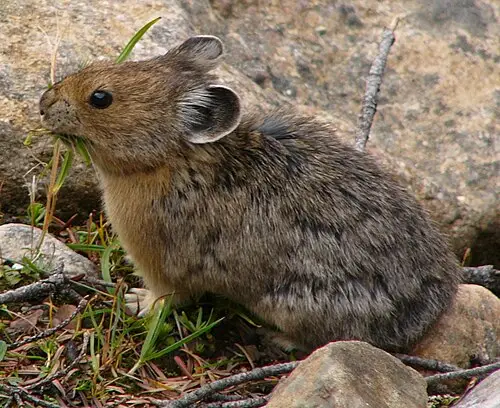
 📸 Photo
Photo: sevenstar · Public domain · Wikimedia Commons Source
American Pika
Ochotona princeps (American Pika · American Pika)
💡 Everyday Comparisons for Size, Mass & Speed
- 💡 Drying and stacking plants into haypiles during summer resembles how people store winter fodder (Comparison).
- 💡 A maximum weight of 176 g is similar to the weight of an apple (about 180–200 g) (Comparison).
- 💡 A maximum length of 21.6 cm is nearly equal to the short side of an A4 sheet of paper (21 cm) (Comparison).
Reference standards: coach bus ~12 m, mid-size car ~4.9 m, compact car ~1 t, basketball hoop 3.05 m, credit card 8.56 cm.
Site-computed relative index from recorded values; not a formal scientific metric.
📖 1. Overview
The American Pika is a small lagomorph living on rocky mountain slopes of North America that dries and piles up plants for winter.
🦴 2. Anatomy & Morphology
It has an egg-shaped body, short ears, short legs, and no visible tail. Its whiskers are 40–77 mm long, and it has 5 toes on the front feet and 4 on the hind feet.
🔍 3. Ecology & Behavior
Active by day, it shelters in rock crevices rather than digging burrows and tunnels through snow in winter. Individuals defend solitary territories, and summer haypiles can contain up to 30 plant species for winter food.
🇰🇷 4. Connection to Korea
No direct record connecting this species to Korea has been found.
📚 Sources & References
- • IUCN Red List LC (2016) — https://www.iucnredlist.org/species/41267/45184315
- • IUCN Red List category LC — latest assessment at iucnredlist.org
- • mammaldiversity.org — 1001171
- • iucnredlist.org — 45184315
- • wikidata.org — Q469908
- • commons.wikimedia.org — File:Ochotona princeps rockies.JPG
- • animaldiversity.org — Ochotona princeps
- • Silhouette: PhyloPic — Margot Michaud · CC0 1.0
Recorded dimensions are widely cited representative estimates from public literature and may vary by study or specimen.