 📸 Photo
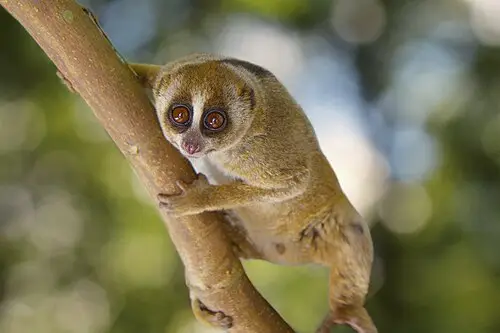
Photo: Lucie Čižmářová, The Kukang Rescue Program · CC BY-SA 4.0 · Wikimedia Commons Source
Malaysian Slow Loris
Nycticebus coucang (Malaysian Slow Loris · スンダスローロリス)
💡 Everyday Comparisons for Size, Mass & Speed
- 💡 It is sold as an exotic pet in Southeast Asia and Western countries, and traffickers often pull out its teeth to prevent bites, frequently causing fatal infections.
- 💡 A weight of about 685 g is slightly heavier than a 500 mL bottle of water (Comparison).
- 💡 Its fur and meat are sometimes used in folk medicine, driving illegal capture.
Reference standards: coach bus ~12 m, mid-size car ~4.9 m, compact car ~1 t, basketball hoop 3.05 m, credit card 8.56 cm.
Site-computed relative index from recorded values; not a formal scientific metric.
📖 1. Overview
The Malaysian Slow Loris is a small, large-eyed primate that moves slowly at night through the forests of Southeast Asia.
🦴 2. Anatomy & Morphology
Being nocturnal, it has large eyes, and it produces a toxic secretion from glands on the inside of its elbows that it spreads over its fur with its toothcomb.
🔍 3. Ecology & Behavior
Its main foods are sap, gum, nectar, and fruit, and it also eats spiders, insects, snails, and bird eggs. It is mostly solitary and gives birth to a single young at a time.
🇰🇷 4. Connection to Korea
No direct record connecting this species to Korea has been found.
📚 Sources & References
- • IUCN Red List EN (2020) — https://www.iucnredlist.org/species/163017685/17970966
- • IUCN Red List category EN — latest assessment at iucnredlist.org
- • mammaldiversity.org — 1001064
- • iucnredlist.org — 17970966
- • wikidata.org — Q688601
- • commons.wikimedia.org — File:Outloň váhavý - autor Lucie Čižmářová.jpg
- • animaldiversity.org — Nycticebus coucang
- • Silhouette: PhyloPic — Mareike C. Janiak · Public Domain Mark 1.0 (Congeneric silhouette — Nycticebus bengalensis)
Recorded dimensions are widely cited representative estimates from public literature and may vary by study or specimen.