 📸 Photo
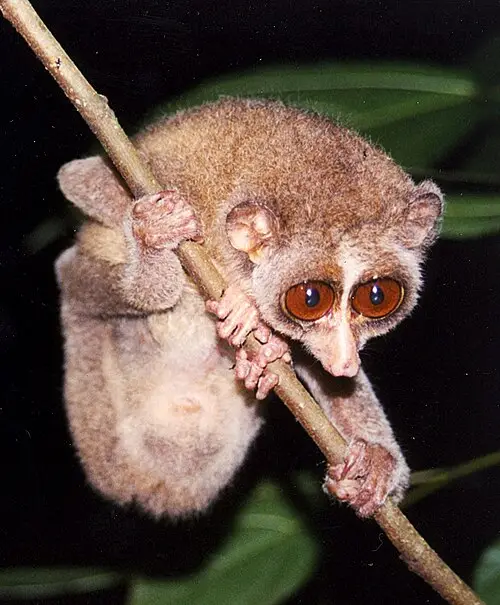
Photo: Dr. K.A.I. Nekaris · CC BY-SA 4.0 · Wikimedia Commons Source
Red Slender Loris
Loris tardigradus (Red Slender Loris · アカホソロリス)
💡 Everyday Comparisons for Size, Mass & Speed
- 💡 Its maximum weight of 227 g is about the weight of four eggs (about 60 g each) (Comparison).
- 💡 Its normal moving speed of 0.59 m/s is about 2.1 km/h, around half of human walking speed (4–5 km/h) (Comparison).
- 💡 Through illegal hunting, it is exploited for traditional medicine and the pet trade (ADW positive impacts).
Reference standards: coach bus ~12 m, mid-size car ~4.9 m, compact car ~1 t, basketball hoop 3.05 m, credit card 8.56 cm.
Site-computed relative index from recorded values; not a formal scientific metric.
📖 1. Overview
The Red Slender Loris is a small nocturnal primate living only in Sri Lanka, famous for moving very slowly and silently.
🦴 2. Anatomy & Morphology
It has long, slender limbs, no tail, large ears, and large forward-facing eyes. Dark patches surround the eyes, and a white stripe runs from the forehead to the nose.
🔍 3. Ecology & Behavior
Feeding mainly on insects—including toxic or distasteful ones—it is thought to wash itself with urine before eating to mask its scent. Active in trees at night, its movements are slow and fluid.
🇰🇷 4. Connection to Korea
No direct record connecting this species to Korea has been found.
📚 Sources & References
- • IUCN Red List EN (2022) — https://www.iucnredlist.org/species/12375/217756381
- • IUCN Red List category EN — latest assessment at iucnredlist.org
- • mammaldiversity.org — 1001060
- • iucnredlist.org — 217756381
- • wikidata.org — Q614947
- • commons.wikimedia.org — File:Loris tardigradus tardigradus 001.jpg
- • animaldiversity.org — Loris tardigradus
- • Silhouette: PhyloPic — Kai Caspar · CC BY 4.0 (Congeneric silhouette — Loris lydekkerianus)
Recorded dimensions are widely cited representative estimates from public literature and may vary by study or specimen.