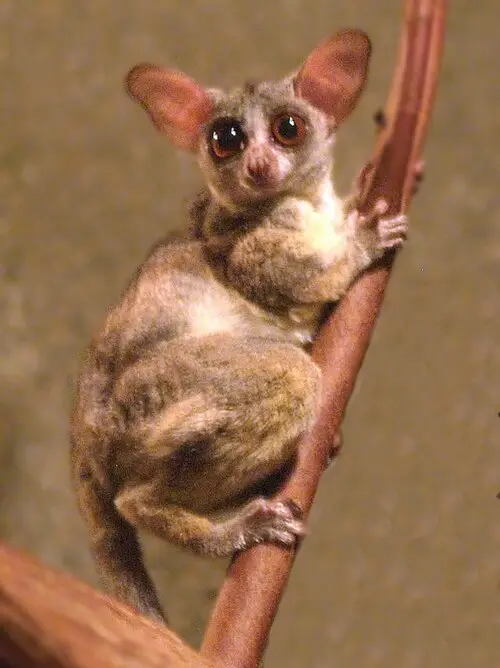
 📸 Photo
Photo: OpenCage · CC BY-SA 2.5 · Wikimedia Commons Source
Northern Lesser Galago
Galago senegalensis (Northern Lesser Galago · ショウガラゴ)
💡 Everyday Comparisons for Size, Mass & Speed
- 💡 A single leap of 3–5 m is about the length of a passenger car (about 4.5 m) (Comparison).
- 💡 With its small size, big eyes, and fluffy fur, it is kept as a pet in Africa (ADW).
- 💡 Its maximum weight of 300 g is about the weight of five chicken eggs (about 60 g each) (Comparison).
Reference standards: coach bus ~12 m, mid-size car ~4.9 m, compact car ~1 t, basketball hoop 3.05 m, credit card 8.56 cm.
Site-computed relative index from recorded values; not a formal scientific metric.
📖 1. Overview
The Northern Lesser Galago is a small nocturnal primate living in the dry woodlands of sub-Saharan Africa, famous for leaping long distances in a single bound.
🦴 2. Anatomy & Morphology
Its fur is thick, soft, wavy, and silvery-gray to brown. Its large ridged ears can fold back, and thick pads of skin at the tips of its fingers and toes help it grip branches firmly.
🔍 3. Ecology & Behavior
It favors grasshoppers most of all and also eats small birds, eggs, fruits, seeds, and flowers, subsisting solely on acacia gum during droughts. It sleeps in groups by day and forages alone at night, leaping 3–5 m in a single bound.
🇰🇷 4. Connection to Korea
No direct record connecting this species to Korea has been found.
📚 Sources & References
- • IUCN Red List LC (2019) — https://www.iucnredlist.org/species/8789/17963505
- • IUCN Red List category LC — latest assessment at iucnredlist.org
- • mammaldiversity.org — 1001045
- • iucnredlist.org — 17963505
- • wikidata.org — Q77332
- • commons.wikimedia.org — File:Galago senegalensis.jpg
- • animaldiversity.org — Galago senegalensis
- • Silhouette: PhyloPic — Kai Caspar · CC0 1.0
Recorded dimensions are widely cited representative estimates from public literature and may vary by study or specimen.