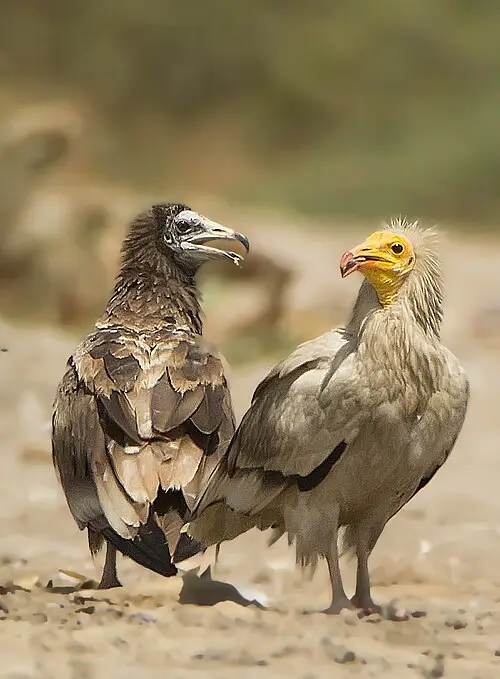
 📸 Photo
Photo: Saswat Mishra · CC BY-SA 4.0 · Wikimedia Commons Source
Egyptian Vulture
Neophron percnopterus (Egyptian Vulture · エジプトハゲワシ)
💡 Everyday Comparisons for Size, Mass & Speed
- 💡 Its average weight of 1.889 kg is almost the same as a 2 L carton of milk (about 2 kg) (Comparison).
- 💡 According to ADW, it cleans up carcasses near human settlements that could cause disease, and it is carved on ancient Egyptian monuments and hieroglyphs.
Reference standards: coach bus ~12 m, mid-size car ~4.9 m, compact car ~1 t, basketball hoop 3.05 m, credit card 8.56 cm.
Site-computed relative index from recorded values; not a formal scientific metric.
📖 1. Overview
The Egyptian Vulture is a scavenger bird with a white head and back and a featherless face that also appears in ancient Egyptian culture. During the breeding season, its face changes from yellow to orange.
🦴 2. Anatomy & Morphology
The flight feathers are nearly black, a collar of spiky feathers surrounds the neck, and the face is featherless. Its bill is large and narrow with a curved tip to pick the last scraps of flesh from between bones.
🔍 3. Ecology & Behavior
It feeds mostly on carrion, but also eats insects, small reptiles and mammals, crustaceans, snails, bird eggs, and nestlings. It is one of the few birds that uses stones as tools to crack open large eggs.
🇰🇷 4. Connection to Korea
No direct record connecting this species to Korea has been found.
📚 Sources & References
- • IUCN Red List EN (2021) — https://www.iucnredlist.org/species/22695180/205187871
- • IUCN Red List category EN — latest assessment at iucnredlist.org
- • doi.org — avilist.v2026
- • iucnredlist.org — 205187871
- • wikidata.org — Q33504
- • commons.wikimedia.org — File:Egyptian Vultures - Immature(L) and Adult (R).jpg
- • animaldiversity.org — Neophron percnopterus
- • Silhouette: PhyloPic — Andy Wilson · CC0 1.0
Recorded dimensions are widely cited representative estimates from public literature and may vary by study or specimen.