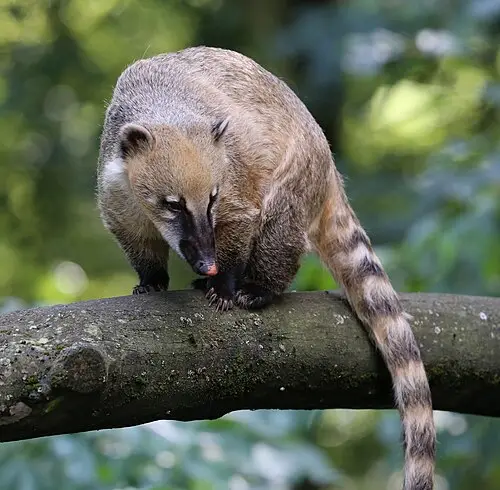
 📸 Photo
Photo: Rufus46 · CC BY-SA 3.0 · Wikimedia Commons Source
South American Coati
Nasua nasua (South American Coati · アカハナグマ)
💡 Everyday Comparisons for Size, Mass & Speed
- 💡 A total length of 1.36 m from head to tail tip is just over two-thirds the length of a single bed (about 2 m) (Comparison).
- 💡 A weight of 6 kg equals the weight of 3 two-liter bottles of water (Comparison).
- 💡 It sometimes enters human homes to rummage through garbage, is hunted locally for food, and has a small demand in the pet trade (ADW).
Reference standards: coach bus ~12 m, mid-size car ~4.9 m, compact car ~1 t, basketball hoop 3.05 m, credit card 8.56 cm.
Site-computed relative index from recorded values; not a formal scientific metric.
📖 1. Overview
The South American Coati is an omnivore with an elongated, slightly upturned nose and a yellow-ringed tail. Mothers and young form bands of up to 30 individuals.
🦴 2. Anatomy & Morphology
It has a narrow head and a long, flexible nose well suited for finding food under leaf litter. Its back is dark brown, gray, or reddish-brown, its belly is white, and its long balancing tail is black to brown with yellow rings.
🔍 3. Ecology & Behavior
It favors fruits and invertebrates and also eats eggs, lizards, small mammals, and carrion. Active by day, it climbs trees and swims well, and sleeps, mates, and gives birth in trees.
🇰🇷 4. Connection to Korea
No direct record connecting this species to Korea has been found.
📚 Sources & References
- • IUCN Red List LC (2016) — https://www.iucnredlist.org/species/41684/45216227
- • IUCN Red List category LC — latest assessment at iucnredlist.org
- • mammaldiversity.org — 1005888
- • iucnredlist.org — 45216227
- • wikidata.org — Q148462
- • commons.wikimedia.org — File:Nasenbaer Nasua nasua Zoo Augsburg-04.jpg
- • animaldiversity.org — Nasua nasua
- • Silhouette: PhyloPic — Margot Michaud · CC0 1.0
Recorded dimensions are widely cited representative estimates from public literature and may vary by study or specimen.