 📸 Photo
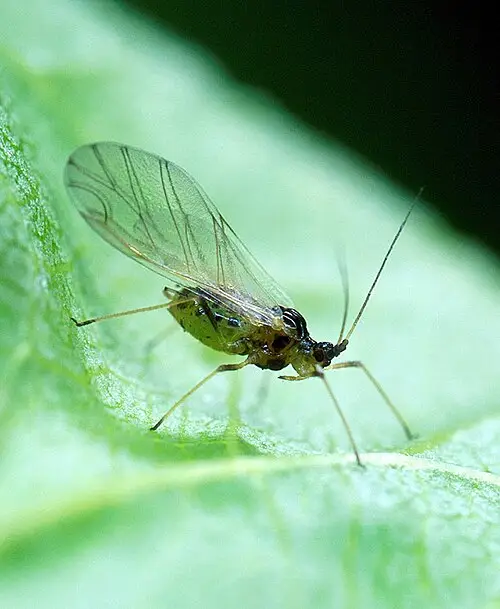
Photo: Scott Bauer · Public domain · Wikimedia Commons Source
Green peach aphid
Myzus persicae (Green peach aphid · モモアカアブラムシ)
Not Evaluated (NE) on the IUCN Red List yet.
💡 Everyday Comparisons for Size, Mass & Speed
- 💡 It uses Prunus fruit trees such as peach trees as its winter host and also curls young leaves (National List of Species of Korea).
- 💡 Living across diverse plants in about 40 families, it is a major pest worldwide that transmits viral diseases to many plants (National List of Species of Korea).
Reference standards: coach bus ~12 m, mid-size car ~4.9 m, compact car ~1 t, basketball hoop 3.05 m, credit card 8.56 cm.
📖 1. Overview
The green peach aphid is a polyphagous aphid that uses peach trees as its winter host and spreads across plants in about 40 families.
🦴 2. Anatomy & Morphology
Its body color varies widely from pale yellowish green and green to pink, red, and black, and it lacks gloss and wax. The antennae are almost equal to the body length, and winged individuals have a large black patch in the center of the abdomen.
🔍 3. Ecology & Behavior
It has a holocyclic life cycle in cold regions and an anholocyclic life cycle in warm regions, occurring year-round and usually maintaining its lineage through parthenogenesis (females reproducing alone). On its primary host, peach, it curls young leaves, and it is a major pest that transmits viral diseases to many plants.
🇰🇷 4. Connection to Korea
According to the National List of Species of Korea, it is distributed in central and southern Korea and Jeju Island.
📚 Sources & References
- • IUCN Red List: not evaluated (NE) — cross-checked with the Wikidata conservation-status entry
- • catalogueoflife.org — 45J3R
- • 국가생물종목록(국립생물자원관) ktsn 120000109785 — https://species.nibr.go.kr/home/mainHome.do?cont_link=009&subMenu=009002&contCd=009002&ktsn=120000109785
- • wikidata.org — Q668208
- • commons.wikimedia.org — File:Myzus persicae.jpg
- • species.nibr.go.kr — mainHome.do
- • Silhouette: PhyloPic — Christoph Schomburg · CC0 1.0 (Related taxon silhouette — Aphididae)
Recorded dimensions are widely cited representative estimates from public literature and may vary by study or specimen.