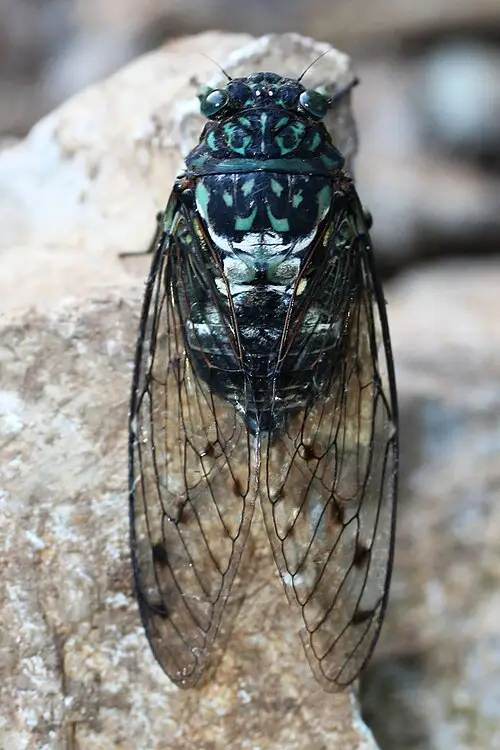
 📸 Photo
Photo: Alpsdake · CC BY-SA 3.0 · Wikimedia Commons Source
Robust cicada
Hyalessa maculaticollis (Robust cicada · ミンミンゼミ)
Not Evaluated (NE) on the IUCN Red List yet.
💡 Everyday Comparisons for Size, Mass & Speed
- 💡 Its body length of 39 mm is about 1.6 times the diameter of a Korean 100-won coin (24 mm) (Comparison).
- 💡 Sitting on tree trunks and calling loudly, it has increased around Tokyo as park trees have grown and created shade, and it is a popular target for children's cicada collecting in Japan (Japanese Ministry of the Environment materials).
Reference standards: coach bus ~12 m, mid-size car ~4.9 m, compact car ~1 t, basketball hoop 3.05 m, credit card 8.56 cm.
📖 1. Overview
The robust cicada is a plant-feeding cicada that calls loudly with a 'maem-maem' sound and lives in association with trees.
🦴 2. Anatomy & Morphology
Its body length is 29–39 mm and reaches 55–63 mm to the wingtips. The dorsal thorax has a variable pattern mixing green and black, and parts of the body are thickly covered with white powder.
🔍 3. Ecology & Behavior
Both adults and nymphs live in association with trees. According to Japanese sources, adults appear from mid-July to early October, peak in early to mid-August, lay eggs in tree bark or dead branches, and spend 2–5 years as nymphs when reared.
🇰🇷 4. Connection to Korea
It is listed as 'Cham-mae-mi' (Korean name) on the National List of Species of Korea, and materials from the Japanese Ministry of the Environment note that it is also distributed on the Korean Peninsula.
📚 Sources & References
- • IUCN Red List: not evaluated (NE) — cross-checked with the Wikidata conservation-status entry
- • catalogueoflife.org — 3MVS2
- • 국가생물종목록(국립생물자원관) ktsn 120000229772 — https://species.nibr.go.kr/home/mainHome.do?cont_link=009&subMenu=009002&contCd=009002&ktsn=120000229772
- • wikidata.org — Q5976819
- • commons.wikimedia.org — File:Oncotympana maculaticollis in Mount Ibuki.JPG
- • env.go.jp — 000074678.pdf
- • Silhouette: PhyloPic — Caleb Gordon · CC0 1.0 (Related taxon silhouette — Magicicada)
Recorded dimensions are widely cited representative estimates from public literature and may vary by study or specimen.