 📸 Photo
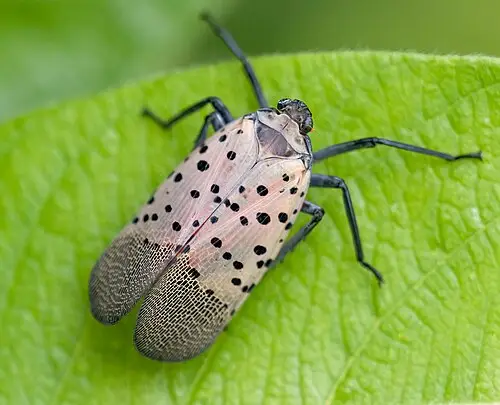
Photo: Rhododendrites · CC BY-SA 4.0 · Wikimedia Commons Source
Spotted lanternfly
Lycorma delicatula (Spotted lanternfly · シタベニハゴロモ)
Not Evaluated (NE) on the IUCN Red List yet.
💡 Everyday Comparisons for Size, Mass & Speed
- 💡 A body length of 27 mm is almost the same as the diameter of a Korean 500-won coin (26.5 mm) (Comparison).
- 💡 In grape, pear, apple, and peach orchards, it sucks sap to wither branches and causes sooty mold with its excrement, harming farms (National List of Species of Korea).
Reference standards: coach bus ~12 m, mid-size car ~4.9 m, compact car ~1 t, basketball hoop 3.05 m, credit card 8.56 cm.
📖 1. Overview
The spotted lanternfly is a hemipteran insect native to southern China and Southeast Asia, and is a pest that sucks tree sap.
🦴 2. Anatomy & Morphology
The forewings are pale ochre with black spots, and the hindwings are black on the outer part and red and white on the inner part. Spreading the wings reveals bright red coloration, and the abdomen is black.
🔍 3. Ecology & Behavior
Both nymphs and adults suck tree sap, causing branches to wither, and their excrement causes sooty mold disease. They are eaten by insectivorous animals such as orb-weaver spiders, dragonflies, and paper wasps, and lay eggs in batches of 20–30 on trees and rocks.
🇰🇷 4. Connection to Korea
According to the National List of Species of Korea, it lives from central Korea northward and is a pest that damages grape, pear, apple, peach, and tree of heaven plants.
📚 Sources & References
- • IUCN Red List: not evaluated (NE) — cross-checked with the Wikidata conservation-status entry
- • catalogueoflife.org — 3WNDJ
- • 국가생물종목록(국립생물자원관) ktsn 120000025977 — https://species.nibr.go.kr/home/mainHome.do?cont_link=009&subMenu=009002&contCd=009002&ktsn=120000025977
- • wikidata.org — Q10571341
- • commons.wikimedia.org — File:Spotted lanternfly in BBG (42972).jpg
- • animaldiversity.org — Lycorma delicatula
- • species.nibr.go.kr — mainHome.do
- • Silhouette: PhyloPic — Andy Wilson · CC0 1.0
Recorded dimensions are widely cited representative estimates from public literature and may vary by study or specimen.