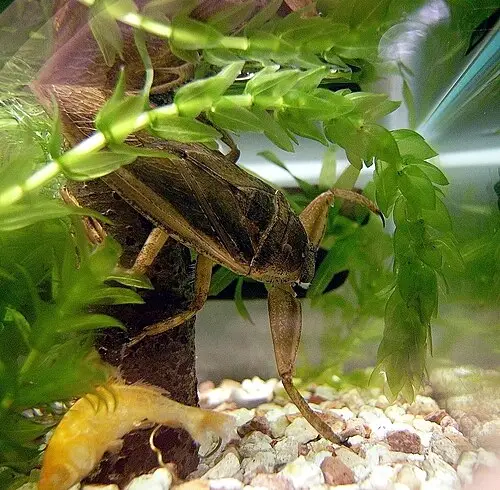
 📸 Photo
Photo: OpenCage · CC BY-SA 2.5 · Wikimedia Commons Source
Oriental giant water bug
Kirkaldyia deyrollei (Oriental giant water bug · Oriental giant water bug)
Not Evaluated (NE) on the IUCN Red List yet.
💡 Everyday Comparisons for Size, Mass & Speed
- 💡 Its body length of 50–60 mm is about two-thirds the width of a credit card (85.6 mm) (Comparison).
- 💡 Heavy pesticide spraying in rice paddies and farmland modification are cited as causes of this insect's decline—a story closely tied to the rice paddies where our rice is grown.
Reference standards: coach bus ~12 m, mid-size car ~4.9 m, compact car ~1 t, basketball hoop 3.05 m, credit card 8.56 cm.
📖 1. Overview
The oriental giant water bug is a large aquatic insect in the family Belostomatidae that catches fish and tadpoles with its sickle-shaped forelegs. In Korea, it is a Class II endangered wildlife (Korea).
🦴 2. Anatomy & Morphology
Its body is 50–60 mm long, forming a narrow, flattened, elongated oval that is yellowish-brown or brown. Its forelegs are flattened, sickle-shaped raptorial legs, and the 8th abdominal segment bears a pair of breathing tubes.
🔍 3. Ecology & Behavior
It preys on aquatic organisms such as small fish, tadpoles, Chinese muddy loaches, and Beodeul-chi (a Korean animal name). Mating begins in late June, and when the female attaches 60–100 eggs to aquatic plants such as cattails, the male guards them until they hatch about 10 days later.
🇰🇷 4. Connection to Korea
Distributed mainly on islands and coasts along the eastern and western seas, inland wetlands, and the Civilian Control Zone, it is a Class II endangered wildlife (Korea). Habitat destruction, water pollution from heavy pesticide use, and farmland improvement projects have reduced its numbers.
📚 Sources & References
- • IUCN Red List: not evaluated (NE) — cross-checked with the Wikidata conservation-status entry
- • catalogueoflife.org — 3R8HY
- • 국가생물종목록(국립생물자원관) ktsn 120000525839 — https://species.nibr.go.kr/home/mainHome.do?cont_link=009&subMenu=009002&contCd=009002&ktsn=120000525839
- • wikidata.org — Q10314429
- • commons.wikimedia.org — File:Lethocerus deyrollei.jpg
- • nie.re.kr — view.do
- • Silhouette: PhyloPic — TGHays · CC BY 4.0 (Related taxon silhouette — Belostoma)
Recorded dimensions are widely cited representative estimates from public literature and may vary by study or specimen.