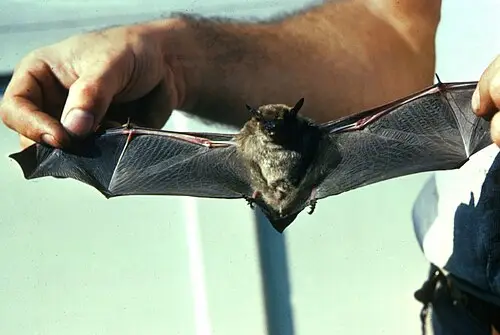
 📸 Photo
Photo: en:Don Pfritzer · Public domain · Wikimedia Commons Source
Little Brown Myotis
Myotis lucifugus (Little Brown Myotis · トビイロホオヒゲコウモリ)
💡 Everyday Comparisons for Size, Mass & Speed
- 💡 It preys on mosquitoes, disease-carrying insects, and agricultural pests.
- 💡 It is widely studied as a model bat species for research on echolocation, social behavior, and foraging.
- 💡 A maximum weight of 14 g is just under two Korean 500-won coins (about 7.7 g each) (Comparison).
Reference standards: coach bus ~12 m, mid-size car ~4.9 m, compact car ~1 t, basketball hoop 3.05 m, credit card 8.56 cm.
Site-computed relative index from recorded values; not a formal scientific metric.
📖 1. Overview
The Little Brown Myotis is a widespread insect-eating bat of North America that catches insects such as mosquitoes near human settlements.
🦴 2. Anatomy & Morphology
Its glossy fur ranges from dark brown to golden brown, reddish, or olive brown, and its wing membranes are dark brown and nearly hairless. It has small ears, large hind feet, and 38 teeth.
🔍 3. Ecology & Behavior
Emerging at dusk, it catches prey in midair or gleans them from leaves. It hibernates from September–November until March–May and does not migrate far to its winter roosts, traveling only up to about 100 miles.
🇰🇷 4. Connection to Korea
No direct record connecting this species to Korea has been found.
📚 Sources & References
- • IUCN Red List EN (2021) — https://www.iucnredlist.org/species/14176/208031565
- • IUCN Red List category EN — latest assessment at iucnredlist.org
- • mammaldiversity.org — 1005432
- • iucnredlist.org — 208031565
- • wikidata.org — Q746127
- • commons.wikimedia.org — File:Little Brown Bat FWS.jpg
- • animaldiversity.org — Myotis lucifugus
- • Silhouette: PhyloPic — Archibald Thorburn · Public Domain Mark 1.0 (Congeneric silhouette — Myotis daubentonii)
Recorded dimensions are widely cited representative estimates from public literature and may vary by study or specimen.