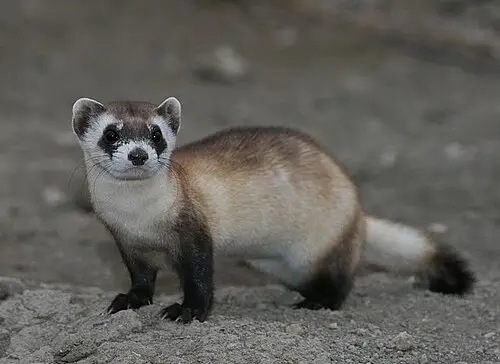
 📸 Photo
Photo: USFWS Mountain Prairie · Public domain · Wikimedia Commons Source
Black-footed Ferret
Mustela nigripes (Black-footed Ferret · クロアシイタチ)
💡 Everyday Comparisons for Size, Mass & Speed
- 💡 A total length of 61 cm including the tail is about twice the long side of an A4 sheet of paper (29.7 cm) (Comparison).
- 💡 A weight of 1.1 kg is slightly heavier than half of a 2-liter bottle of water (Comparison).
- 💡 A single ferret eats more than 100 prairie dogs in 1 year. Because some people regard burrowing prairie dogs as pests, the Black-footed Ferret helps control their numbers (Smithsonian, ADW).
Reference standards: coach bus ~12 m, mid-size car ~4.9 m, compact car ~1 t, basketball hoop 3.05 m, credit card 8.56 cm.
Site-computed relative index from recorded values; not a formal scientific metric.
📖 1. Overview
The Black-footed Ferret is a North American prairie weasel that lives in prairie dog burrows and preys on prairie dogs. Today it has been reintroduced into parts of Wyoming, South Dakota, Montana, and Arizona.
🦴 2. Anatomy & Morphology
It has a slender, wiry body with yellowish-buff fur and a white forehead, muzzle, and throat. It is marked by a black mask around the eyes, black feet, and a black tail tip, and its front paws are well adapted for digging.
🔍 3. Ecology & Behavior
Prairie dogs make up more than 90% of its diet and are hunted inside their burrows. It is nocturnal and solitary, breeds in March–April, and gives birth to 1–6 young (3.5 on average) after a gestation of 35–45 days.
🇰🇷 4. Connection to Korea
No direct record connecting this species to Korea has been found.
📚 Sources & References
- • IUCN Red List EN (2015) — https://www.iucnredlist.org/species/14020/45200314
- • IUCN Red List category EN — latest assessment at iucnredlist.org
- • mammaldiversity.org — 1005873
- • iucnredlist.org — 45200314
- • wikidata.org — Q402885
- • commons.wikimedia.org — File:Mustela nigripes 2.jpg
- • nationalzoo.si.edu — black-footed-ferret
- • animaldiversity.org — Mustela nigripes
- • Silhouette: PhyloPic — Vanessa Guerra · CC0 1.0
Recorded dimensions are widely cited representative estimates from public literature and may vary by study or specimen.