 📸 Photo
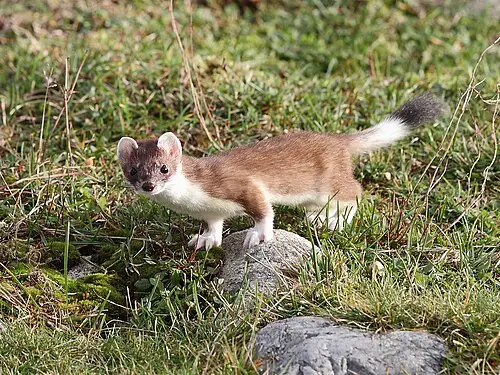
Photo: Marton Berntsen , crop by User:MPF · CC BY-SA 4.0 · Wikimedia Commons Source
Beringian Ermine
Mustela erminea (Beringian Ermine · オコジョ)
💡 Everyday Comparisons for Size, Mass & Speed
- 💡 A body length of 33 cm is nearly twice the length of a new pencil (about 17.5 cm) (Comparison).
- 💡 A maximum weight of 116 g is similar to the weight of two chicken eggs (about 60 g each) (Comparison).
- 💡 Its white winter fur has long been used to trim coats and make stoles, and its skill at catching mice makes it helpful to people (ADW).
Reference standards: coach bus ~12 m, mid-size car ~4.9 m, compact car ~1 t, basketball hoop 3.05 m, credit card 8.56 cm.
Site-computed relative index from recorded values; not a formal scientific metric.
📖 1. Overview
The Beringian Ermine is a small weasel living in northern Eurasia and North America whose coat turns white in winter except for a black tail tip. Despite its small size, it is a skilled hunter of rodents and rabbits.
🦴 2. Anatomy & Morphology
It has a long body, short legs, a triangular head on a long neck, slightly protruding round ears, bright black eyes, and long whiskers. In summer, its back is chocolate brown and its belly is yellowish white.
🔍 3. Ecology & Behavior
It hunts warm-blooded animals up to the size of a rabbit mainly at night, also hunting in tunnels beneath the snow and traveling up to 15 km in a single night. Because embryonic development pauses for 8–9 months, gestation averages 280 days, and females give birth to an average of 4–9 young in April–May.
🇰🇷 4. Connection to Korea
No direct record connecting this species to Korea has been found.
📚 Sources & References
- • IUCN Red List LC (2016) — https://www.iucnredlist.org/species/29674/45203335
- • IUCN Red List category LC — latest assessment at iucnredlist.org
- • mammaldiversity.org — 1005863
- • iucnredlist.org — 45203335
- • wikidata.org — Q25345
- • commons.wikimedia.org — File:Røyskatt (Mustela erminea erminea), Lista, Norway.jpg
- • animaldiversity.org — Mustela erminea
- • Silhouette: PhyloPic — Margot Michaud · CC0 1.0
Recorded dimensions are widely cited representative estimates from public literature and may vary by study or specimen.