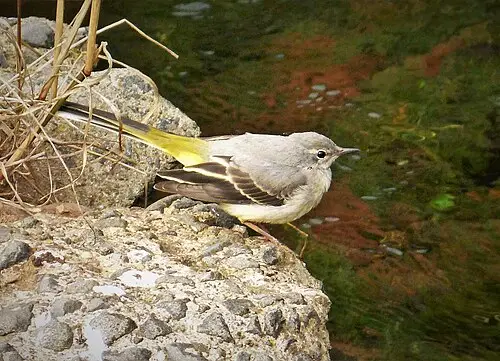
 📸 Photo
Photo: gailhampshire from Cradley, Malvern, U.K · CC BY 2.0 · Wikimedia Commons Source
Grey Wagtail
Motacilla cinerea (Grey Wagtail · キセキレイ)
💡 Everyday Comparisons for Size, Mass & Speed
- 💡 Its body length of 20 cm is the same as the height of a 500 mL plastic bottle (about 20 cm) (Comparison).
- 💡 According to the National List of Species of Korea, it also nests in building crevices, perches on power lines and roofs to sing, and can be recognized by the way it bobs its tail up and down while walking.
Reference standards: coach bus ~12 m, mid-size car ~4.9 m, compact car ~1 t, basketball hoop 3.05 m, credit card 8.56 cm.
📖 1. Overview
The Grey Wagtail is a common summer visitor breeding in Korea, living near waters such as valleys, streams, and ponds. It is distributed across Russia, China, the Korean Peninsula, Japan, and Indochina.
🦴 2. Anatomy & Morphology
Its body length is 20 cm. The upperparts are gray and the underparts are a striking yellow, with a dark gray bill, pink legs, and a longer tail than other wagtails. Males have a black patch on the chin and throat.
🔍 3. Ecology & Behavior
It builds its nest with thin stems and roots in gaps between stones or buildings. When walking on the ground, it bobs its tail up and down, and it flies in an undulating wave pattern.
🇰🇷 4. Connection to Korea
The National List of Species of Korea notes that it lives nationwide and is a summer visitor that commonly breeds in Korea.
📚 Sources & References
- • IUCN Red List LC (2025) — https://www.iucnredlist.org/species/22718392/280921670
- • IUCN Red List category LC — latest assessment at iucnredlist.org
- • doi.org — avilist.v2026
- • iucnredlist.org — 280921670
- • 국가생물종목록(국립생물자원관) ktsn 120000002171 — https://species.nibr.go.kr/home/mainHome.do?cont_link=009&subMenu=009002&contCd=009002&ktsn=120000002171
- • wikidata.org — Q201316
- • commons.wikimedia.org — File:Grey Wagtail Motacilla cinerea (39682090233).jpg
- • species.nibr.go.kr — mainHome.do
- • Silhouette: PhyloPic — Martin Bulla, based on Ren Hathway's illustration · CC BY 4.0 (Congeneric silhouette — Motacilla alba)
Recorded dimensions are widely cited representative estimates from public literature and may vary by study or specimen.