 📸 Photo
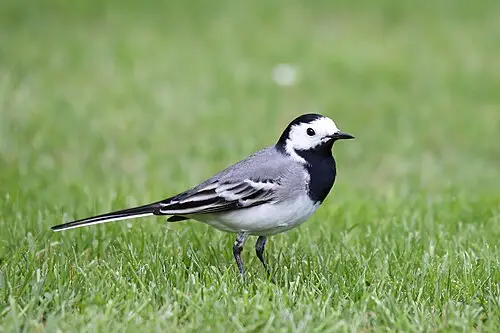
Photo: Jac. Janssen from BAARLO LB, NL · CC BY 2.0 · Wikimedia Commons Source
White Wagtail
Motacilla alba (White Wagtail · タイリクハクセキレイ)
💡 Everyday Comparisons for Size, Mass & Speed
- 💡 Its body length of 21 cm is the same as the short side of an A4 sheet of paper (21 cm) (Comparison).
- 💡 According to the National List of Species of Korea, it is easily spotted on roofs, rooftops, and streams in cities and the countryside, arriving near Seoul by early March.
Reference standards: coach bus ~12 m, mid-size car ~4.9 m, compact car ~1 t, basketball hoop 3.05 m, credit card 8.56 cm.
📖 1. Overview
The White Wagtail is a common bird in the family Motacillidae (order Passeriformes), seen everywhere on roofs and rooftops in cities and rural areas, by streams, and on farmlands. It breeds across the entire Eurasian continent.
🦴 2. Anatomy & Morphology
Its body length is about 21 cm. In male winter plumage, the forehead, sides of the head, sides of the neck, and chin are white, while the entire back from the crown to the uppertail coverts is black. Its bill is thinner than that of Baekhalmisae (a Korean animal name).
🔍 3. Ecology & Behavior
It builds its nest in rock crevices or gaps in house buildings and lays eggs from late April to May. Its main diet consists of spiders and insects.
🇰🇷 4. Connection to Korea
The National List of Species of Korea notes that it is the earliest-arriving summer visitor subspecies to Korea, reaching the outskirts of Seoul by early March.
📚 Sources & References
- • IUCN Red List LC (2019) — https://www.iucnredlist.org/species/22718348/137417893
- • IUCN Red List category LC — latest assessment at iucnredlist.org
- • doi.org — avilist.v2026
- • iucnredlist.org — 137417893
- • 국가생물종목록(국립생물자원관) ktsn 120000002172 — https://species.nibr.go.kr/home/mainHome.do?cont_link=009&subMenu=009002&contCd=009002&ktsn=120000002172
- • wikidata.org — Q25399
- • commons.wikimedia.org — File:20180415 015 Winterswijk Witte kwikstaart (40785272624)
- • species.nibr.go.kr — mainHome.do
- • Silhouette: PhyloPic — Martin Bulla, based on Ren Hathway's illustration · CC BY 4.0
Recorded dimensions are widely cited representative estimates from public literature and may vary by study or specimen.