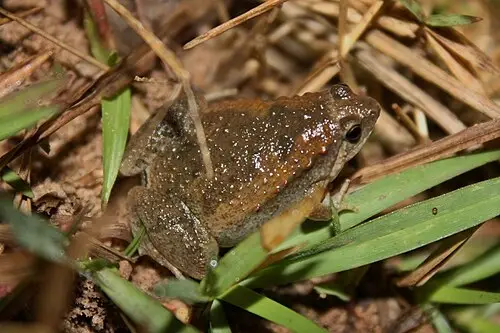
 📸 Photo
Photo: Thomas Brown · CC BY 2.0 · Wikimedia Commons Source
Ornate Narrow-mouthed Frog
Microhyla fissipes (Ornate Narrow-mouthed Frog · Ornate Narrow-mouthed Frog)
💡 Everyday Comparisons for Size, Mass & Speed
- 💡 Its average body length of 2.5 cm is almost the same as a Korean 500-won coin (26.5 mm in diameter), and its maximum of 3 cm is slightly larger (Comparison).
- 💡 Because it hides among fallen leaves and is hard to see, Hong Kong Wetland Park advises visitors to listen for its call rather than look for it by eye (Hong Kong Wetland Park).
Reference standards: coach bus ~12 m, mid-size car ~4.9 m, compact car ~1 t, basketball hoop 3.05 m, credit card 8.56 cm.
📖 1. Overview
The Ornate Narrow-mouthed Frog (Ornate pigmy frog) is a tiny frog living from Japan and south-central China to Southeast Asia. In Hong Kong, it is widely distributed.
🦴 2. Anatomy & Morphology
A tiny frog measuring 2.5–3 cm in body length, it has a triangular body and a pointed snout. Its back is brown with a long, irregular dark-brown pattern, a dark-brown stripe runs from the eye to the groin, and its skin has a few small tubercles.
🔍 3. Ecology & Behavior
It lives in forests, cultivated fields, and ponds, feeding on insects such as ants. Because it blends in among fallen leaves and is hard to spot by sight, it is easier to locate by its distinctive call, and it breeds in the rainy season by floating tiny eggs in a thin film on the water surface.
🇰🇷 4. Connection to Korea
No direct record connecting this species to Korea has been found.
📚 Sources & References
- • IUCN Red List LC (2022) — https://www.iucnredlist.org/species/135848/63886863
- • IUCN Red List category LC — latest assessment at iucnredlist.org
- • catalogueoflife.org — 73GRF
- • iucnredlist.org — 63886863
- • wikidata.org — Q3312201
- • commons.wikimedia.org — File:Ornate Pygmy Frog (Microhyla fissipes).jpg
- • biosch.hku.hk — Microhyla fissipes.htm
- • wetlandpark.gov.hk — microhyla-fissipes
- • bok.or.kr — contents.do
- • Silhouette: PhyloPic — Vijay Karthick · CC0 1.0 (Congeneric silhouette — Microhyla sholigari)
Recorded dimensions are widely cited representative estimates from public literature and may vary by study or specimen.