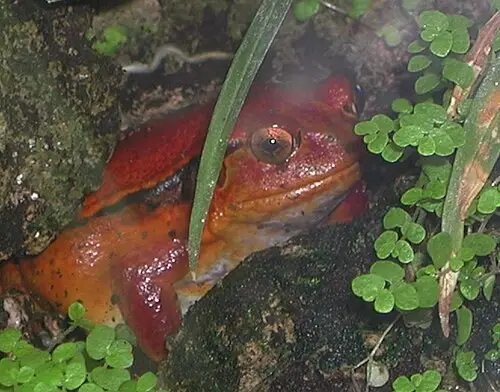
 📸 Photo
Photo: No machine-readable author provided. RicciSpeziari~commonswiki assumed (based on copyright claims). · CC BY-SA 3.0 · Wikimedia Commons Source
Tomato Frog
Dyscophus antongilii (Tomato Frog · アカトマトガエル)
💡 Everyday Comparisons for Size, Mass & Speed
- 💡 The female maximum length of 10.5 cm is almost equal to four Korean 500-won coins (26.5 mm in diameter) lined up (106 mm), and the average weight of 26 g is about three and a half Korean 500-won coins (7.7 g) (Comparison).
- 💡 Popular as an unusual pet for its bright red color, the establishment of captive-bred lines ended the export of wild-caught frogs from Madagascar (ADW).
Reference standards: coach bus ~12 m, mid-size car ~4.9 m, compact car ~1 t, basketball hoop 3.05 m, credit card 8.56 cm.
Site-computed relative index from recorded values; not a formal scientific metric.
📖 1. Overview
The Tomato Frog is a vividly reddish frog found only in the rainforests and swamp forests of Madagascar's eastern rainforest belt. It also adapts well to urban environments.
🦴 2. Anatomy & Morphology
True to its name, it has a tomato-like reddish-orange color, with females (8.5–10.5 cm) larger and redder than males (6–6.5 cm). A dark brown stripe runs from behind the eye to the hind leg, the belly is pale white, and the skin secretes a toxic substance.
🔍 3. Ecology & Behavior
It stays burrowed in leaf litter and mud during the day and moves across the forest floor at night to eat insects, insect larvae, and worms. It breeds during heavy rains in the wet season, and eggs are found nearly year-round.
🇰🇷 4. Connection to Korea
No direct record connecting this species to Korea has been found.
📚 Sources & References
- • IUCN Red List LC (2017) — https://www.iucnredlist.org/species/6937/84159360
- • IUCN Red List category LC — latest assessment at iucnredlist.org
- • catalogueoflife.org — 388VL
- • iucnredlist.org — 84159360
- • wikidata.org — Q226081
- • commons.wikimedia.org — File:Dählhölzli - Tomatenfrosch 2.jpg
- • animaldiversity.org — Dyscophus antongilii
- • nationalzoo.si.edu — tomato-frog
- • bok.or.kr — contents.do
- • Silhouette: PhyloPic — Vijay Karthick · CC0 1.0 (Related taxon silhouette — Microhyla sholigari)
Recorded dimensions are widely cited representative estimates from public literature and may vary by study or specimen.