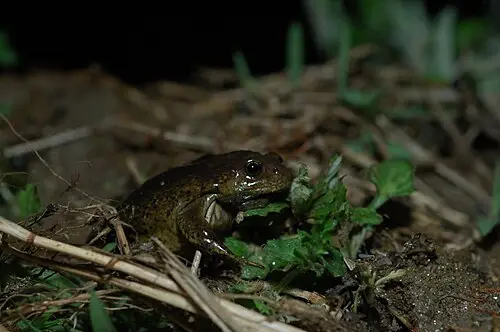
 📸 Photo
Photo: Pierre Fidenci · CC BY-SA 3.0 · Wikimedia Commons Source
Boreal Digging Frog
Kaloula borealis (Boreal Digging Frog · ジムグリガエル)
🇰🇷 Class II endangered wildlife (Korea)
💡 Everyday Comparisons for Size, Mass & Speed
- 💡 Its body length of 5.5 cm is about two-thirds the width of a credit card (about 8.6 cm) (Comparison).
- 💡 Its Korean name 'Maengkkongi' comes from its 'maeng-maeng-maeng' and 'kkong-kkong-kkong' calls, and on rainy or cloudy days during the monsoon season, males also call by day to attract females.
- 💡 Because it lives underground near puddles around villages and forest edges, it cannot be heard or seen outside the spawning season.
Reference standards: coach bus ~12 m, mid-size car ~4.9 m, compact car ~1 t, basketball hoop 3.05 m, credit card 8.56 cm.
📖 1. Overview
The Boreal Digging Frog is a frog with a small head and very short legs that spends most of its time underground. It is designated as Class II endangered wildlife (Korea) and listed as Least Concern (LC, 2020) on the IUCN Red List.
🦴 2. Anatomy & Morphology
Its back is dark brown with scattered small yellow spots and small round tubercles on the nape and back. When touched, its skin and tubercles secrete white mucus, and breeding males have a single vocal sac under the chin that hangs down darkly.
🔍 3. Ecology & Behavior
Active from April to October before hibernating, it comes out at night to prey on ants, flies, ground beetles, and spiders. During the monsoon season from June to August, it gathers at the water's edge to lay about 2,000 eggs at a time, which float separately one by one rather than in clumps.
🇰🇷 4. Connection to Korea
It is Class II endangered wildlife (Korea) living nationwide including Jeju Island. Its Korean name 'Maengkkongi' comes from its 'maeng-maeng-maeng' and 'kkong-kkong-kkong' calls, and outside the spawning season it is hard to hear or see.
📚 Sources & References
- • IUCN Red List LC (2020) — https://www.iucnredlist.org/species/57849/63887081
- • 멸종위기 야생생물 Ⅱ급 — 국가생물종목록(국립생물자원관) ktsn 120000001384 — https://species.nibr.go.kr/home/mainHome.do?cont_link=009&subMenu=009002&contCd=009002&ktsn=120000001384
- • IUCN Red List category LC — latest assessment at iucnredlist.org
- • Korean protection status: Class II endangered wildlife (Korea)
- • catalogueoflife.org — 3QZKK
- • iucnredlist.org — 63887081
- • 국가생물종목록(국립생물자원관) ktsn 120000001384 — https://species.nibr.go.kr/home/mainHome.do?cont_link=009&subMenu=009002&contCd=009002&ktsn=120000001384
- • wikidata.org — Q1071723
- • commons.wikimedia.org — File:Kaloula borealis01.jpeg
- • nie.re.kr — view.do
- • species.nibr.go.kr — mainHome.do
- • Silhouette: PhyloPic — Vijay Karthick · CC0 1.0 (Related taxon silhouette — Microhyla sholigari)
Recorded dimensions are widely cited representative estimates from public literature and may vary by study or specimen.