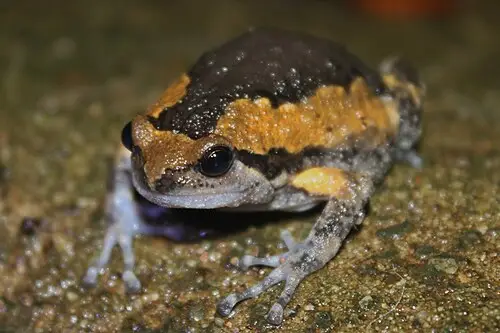
 📸 Photo
Photo: Thomas Brown · CC BY 2.0 · Wikimedia Commons Source
Banded Bullfrog
Kaloula pulchra (Banded Bullfrog · アジアジムグリガエル)
💡 Everyday Comparisons for Size, Mass & Speed
- 💡 Its maximum length of 7.5 cm is slightly shorter than three Korean 500-won coins (26.5 mm in diameter) lined up side by side (79.5 mm) (Comparison).
- 💡 In Hong Kong it is found not only in forests but also in manholes and artificial ponds, and during the summer breeding season it calls with a loud sound like a bellowing bull (University of Hong Kong Amphibian Database, Hong Kong Wetland Park).
Reference standards: coach bus ~12 m, mid-size car ~4.9 m, compact car ~1 t, basketball hoop 3.05 m, credit card 8.56 cm.
📖 1. Overview
The Banded Bullfrog is a plump medium-sized frog living from South Asia to southern China. In Hong Kong, it uses everything from forests and farmland to urban structures such as manholes.
🦴 2. Anatomy & Morphology
Measuring 5–7.5 cm in body length, it has a small head and a chubby body. Its back is dark brown with orange or pink bands and its belly is mottled brown, while its hind feet have spade-like horny tubercles for digging and its front feet have adhesive pads for climbing steep surfaces.
🔍 3. Ecology & Behavior
It burrows into the ground and eats earthworms and insects such as ants, inflating its body and secreting sticky mucus when disturbed. It breeds after rain in the warm season, and males call females in summer with a loud bellow like a bull.
🇰🇷 4. Connection to Korea
No direct record connecting this species to Korea has been found.
📚 Sources & References
- • IUCN Red List LC (2022) — https://www.iucnredlist.org/species/88333729/63887207
- • IUCN Red List category LC — latest assessment at iucnredlist.org
- • catalogueoflife.org — 3QZL4
- • iucnredlist.org — 63887207
- • wikidata.org — Q931167
- • commons.wikimedia.org — File:Asiatic Painted Frog (Kaloula pulchra) 花狹口蛙2.jpg
- • biosch.hku.hk — Kaloula pulchra pulchra.htm
- • wetlandpark.gov.hk — kaloula-pulchra-pulchra
- • bok.or.kr — contents.do
- • Silhouette: PhyloPic — Vijay Karthick · CC0 1.0 (Related taxon silhouette — Microhyla sholigari)
Recorded dimensions are widely cited representative estimates from public literature and may vary by study or specimen.