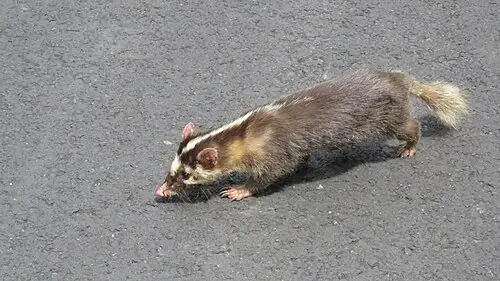
 📸 Photo
Photo: Heng Chian Li · CC BY 4.0 · Wikimedia Commons Source
Formosan Ferret-badger
Melogale subaurantiaca (Formosan Ferret-badger · Formosan Ferret-badger)
Not Evaluated (NE) on the IUCN Red List yet.
💡 Everyday Comparisons for Size, Mass & Speed
- 💡 A head-and-body length of 40 cm is about 1.3 times the long side of an A4 sheet of paper (29.7 cm) (Comparison).
- 💡 A weight of 1.7 kg is about 8 tenths the weight of one 2-liter bottle of water (Comparison).
- 💡 In Taiwan, it is classified as 'General Wildlife' not specially protected by law (Taipei Zoo materials).
Reference standards: coach bus ~12 m, mid-size car ~4.9 m, compact car ~1 t, basketball hoop 3.05 m, credit card 8.56 cm.
Site-computed relative index from recorded values; not a formal scientific metric.
📖 1. Overview
The Formosan Ferret-badger is a small mustelid living in Taiwan; Taipei Zoo materials list its scientific name as Melogale moschata subaurantiaca. Active at night, it is classified as a general wildlife species in Taiwan.
🦴 2. Anatomy & Morphology
Its back ranges from grayish-brown to brownish-black with a paler belly, and a white longitudinal stripe runs from the top of the head down the back of the neck to the middle of the back. Its legs are short and its feet broad with long, strong claws suited for digging, while its tail is bushy with long white hairs.
🔍 3. Ecology & Behavior
An omnivore that eats frogs, lizards, small rodents, insects, earthworms, snails, and fruits. Its scent glands are well developed, and when startled or cornered it releases a foul odor to drive away predators.
🇰🇷 4. Connection to Korea
No direct record connecting this species to Korea has been found.
📚 Sources & References
- • IUCN Red List: not evaluated (NE) — cross-checked with the Wikidata conservation-status entry
- • mammaldiversity.org — 1005831
- • wikidata.org — Q107473188
- • commons.wikimedia.org — File:Melogale subaurantiaca 151917951.jpg
- • cdc.gov.tw — 0675e0e3-d0d4-4666-96ef-07273e48e1aa.pdf
- • Silhouette: PhyloPic — Margot Michaud · CC0 1.0 (Congeneric silhouette — Melogale moschata)
Recorded dimensions are widely cited representative estimates from public literature and may vary by study or specimen.