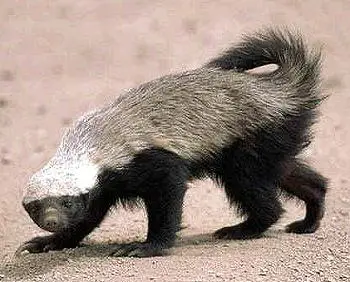
 📸 Photo
Photo: en:User:Jaganath · CC BY-SA 3.0 · Wikimedia Commons Source
Honey Badger
Mellivora capensis (Honey Badger · ラーテル)
💡 Everyday Comparisons for Size, Mass & Speed
- 💡 A body length of 70 cm is about 2.4 times the long side of an A4 sheet of paper (29.7 cm) (Comparison).
- 💡 A weight of 12 kg is slightly heavier than a 10 kg bag of rice (Comparison).
- 💡 By catching many rats and insects, it reduces disease-carrying pests, and beekeepers watch this animal as a guide to locate wild beehives (ADW).
Reference standards: coach bus ~12 m, mid-size car ~4.9 m, compact car ~1 t, basketball hoop 3.05 m, credit card 8.56 cm.
Site-computed relative index from recorded values; not a formal scientific metric.
📖 1. Overview
The Honey Badger is a large mustelid living widely from sub-Saharan Africa to Arabia and India, famous for its ferocity. It can live almost anywhere as long as there are shelters like burrows or rock crevices.
🦴 2. Anatomy & Morphology
It measures 60–70 cm in body length and weighs 8–12 kg, with males larger than females. Older males have overlapping bite scars on their backs and are called 'scarbacks'.
🔍 3. Ecology & Behavior
Wandering alone, it eats eggs, rodents, snakes, birds, and frogs as well as fruits and roots, and relishes bee larvae and honey from hives. Females travel about 10 km a day and males up to 27 km in search of food.
🇰🇷 4. Connection to Korea
No direct record connecting this species to Korea has been found.
📚 Sources & References
- • IUCN Red List LC (2016) — https://www.iucnredlist.org/species/41629/45210107
- • IUCN Red List category LC — latest assessment at iucnredlist.org
- • mammaldiversity.org — 1005860
- • iucnredlist.org — 45210107
- • wikidata.org — Q173128
- • commons.wikimedia.org — File:Honey badger.jpg
- • animaldiversity.org — Mellivora capensis
- • Silhouette: PhyloPic — Steven Traver · CC0 1.0
Recorded dimensions are widely cited representative estimates from public literature and may vary by study or specimen.