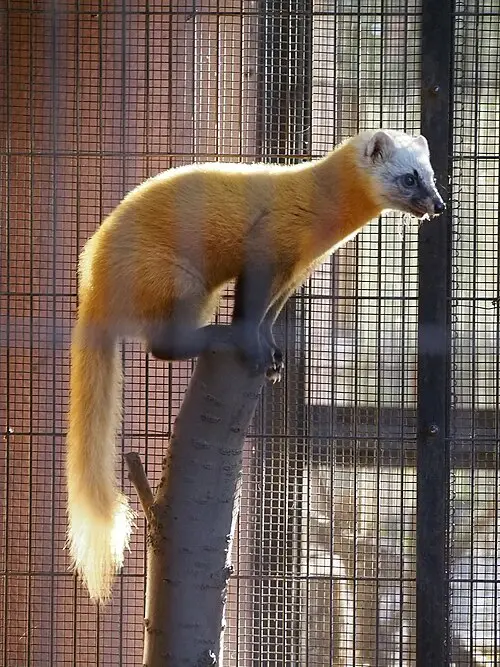
 📸 Photo
Photo: Kestrel · CC BY-SA 4.0 · Wikimedia Commons Source
Japanese Marten
Martes melampus (Japanese Marten · ニホンテン)
💡 Everyday Comparisons for Size, Mass & Speed
- 💡 Its head-and-body length of 54.5 cm is just under twice the long side of an A4 sheet of paper (29.7 cm) (Comparison).
- 💡 The National List of Species of Korea notes that in autumn it climbs persimmon trees to pick and eat persimmons.
- 💡 In Japan, fur trapping is permitted from December 1 to January 31, while it is protected in Hokkaido and Tsushima (ADW).
Reference standards: coach bus ~12 m, mid-size car ~4.9 m, compact car ~1 t, basketball hoop 3.05 m, credit card 8.56 cm.
Site-computed relative index from recorded values; not a formal scientific metric.
📖 1. Overview
The Japanese Marten is a marten species living in Japan, active in forests at night and early in the morning. In Korea, there are occurrence records from Cheonan, Seonghwan, Gwangneung, and Ttukseom.
🦴 2. Anatomy & Morphology
Its body is usually yellowish-white though sometimes dark brown, and its face is mostly white. Similar in body size to the Sable, it has a much longer tail and shorter but wider earlobes.
🔍 3. Ecology & Behavior
An opportunistic omnivore, it feeds mainly on rodents and wild birds while also catching grass lizards, frogs, and Siberian Flying Squirrels, and enjoys fruits and insects according to the season. Mating in spring, it gives birth to an average of 1.5 young per litter from mid-July to early August.
🇰🇷 4. Connection to Korea
The National List of Species of Korea notes occurrence records in Cheonan, Seonghwan, Gwangneung, and Ttukseom, while globally it is distributed only in Japan.
📚 Sources & References
- • IUCN Red List LC (2015) — https://www.iucnredlist.org/species/41650/45213228
- • IUCN Red List category LC — latest assessment at iucnredlist.org
- • mammaldiversity.org — 1005823
- • iucnredlist.org — 45213228
- • 국가생물종목록(국립생물자원관) ktsn 120000053331 — https://species.nibr.go.kr/home/mainHome.do?cont_link=009&subMenu=009002&contCd=009002&ktsn=120000053331
- • wikidata.org — Q1052830
- • commons.wikimedia.org — File:Inokashira Park Zoo PC053197.jpg
- • animaldiversity.org — Martes melampus
- • species.nibr.go.kr — mainHome.do
- • Silhouette: PhyloPic — Margot Michaud · CC0 1.0
Recorded dimensions are widely cited representative estimates from public literature and may vary by study or specimen.