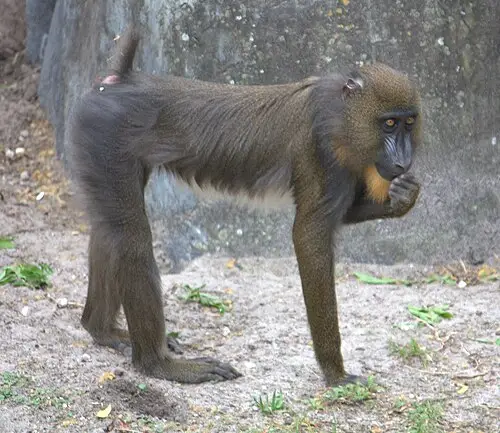
 📸 Photo
Photo: LaggedOnUser · CC BY-SA 2.0 · Wikimedia Commons Source
Mandrill
Mandrillus sphinx (Mandrill · マンドリル)
💡 Everyday Comparisons for Size, Mass & Speed
- 💡 Its upper weight limit of 54 kg is about two and a half 20 kg bags of rice (Comparison).
- 💡 Its height of 80 cm is slightly taller than a standard desk (about 70–75 cm) (Comparison).
- 💡 Because of its long lifespan it can be seen in zoos for many years, and in some regions it is hunted for meat (ADW positive impacts).
Reference standards: coach bus ~12 m, mid-size car ~4.9 m, compact car ~1 t, basketball hoop 3.05 m, credit card 8.56 cm.
Site-computed relative index from recorded values; not a formal scientific metric.
📖 1. Overview
The Mandrill is a large monkey living in African tropical rainforests, famous for the vivid colors on its face and rump.
🦴 2. Anatomy & Morphology
It has a large head, a compact body, and long, powerful limbs. Along with olive-green fur, it has a red stripe down the middle of the nose, blue ridges along the sides of the muzzle, and a blue-to-purple rump.
🔍 3. Ecology & Behavior
An omnivore that eats fruit, seeds, mushrooms, roots, insects, snails, frogs, and lizards, it forms groups ranging from a few individuals up to 50, and when excited, the blue coloring on its rump and chest becomes brighter.
🇰🇷 4. Connection to Korea
No direct record connecting this species to Korea has been found.
📚 Sources & References
- • IUCN Red List VU (2019) — https://www.iucnredlist.org/species/12754/17952325
- • IUCN Red List category VU — latest assessment at iucnredlist.org
- • mammaldiversity.org — 1000627
- • iucnredlist.org — 17952325
- • wikidata.org — Q189868
- • commons.wikimedia.org — File:Mandrill (4531340530).jpg
- • animaldiversity.org — Mandrillus sphinx
- • Silhouette: PhyloPic — Steven Traver · CC0 1.0
Recorded dimensions are widely cited representative estimates from public literature and may vary by study or specimen.