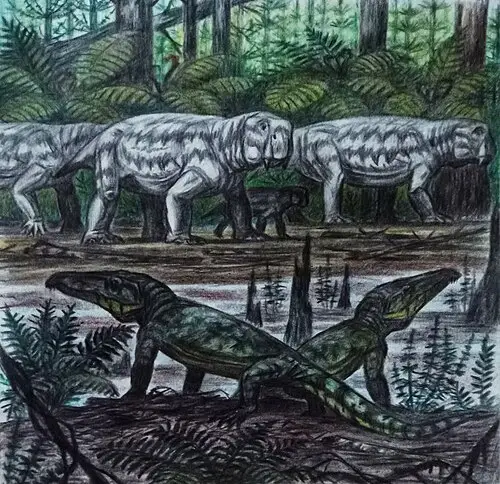
 🎨 Restoration
Restoration: ABelov2014 · CC BY-SA 3.0 · Wikimedia Commons Source
Life restorations are artistic reconstructions based on fossil evidence; true coloration and soft-tissue details remain uncertain.
Lystrosaurus
Lystrosaurus murrayi (Lystrosaurus · Lystrosaurus)
Known only from fossils. The IUCN Red List assesses only species extant since 1500 CE, so fossil taxa are not assigned a category.
💡 Everyday Comparisons for Size, Mass & Speed
- 💡 The Geological Society of London's description (representative value for the genus) lists its length as about 1 m, which is about the height of a lower-grade elementary school child (Comparison).
- 💡 Because fossils of the same genus have been found in South Africa, India, and Antarctica, they have been used as evidence that the continents were once joined together.
Reference standards: coach bus ~12 m, mid-size car ~4.9 m, compact car ~1 t, basketball hoop 3.05 m, credit card 8.56 cm.
📖 1. Overview
Lystrosaurus murrayi (genus Lystrosaurus) was a pig-like, stocky herbivorous dicynodont belonging to one of the few land vertebrate groups to survive the end-Permian mass extinction. This species lived exclusively in the Triassic.
🦴 2. Anatomy & Morphology
It had a stocky, pig-like body and tusks. Bone tissue studies show that even the largest specimens of this species were not fully grown adults, and its bone structure—resembling that of large terrestrial dicynodonts—indicates that it was a fully land-dwelling animal.
🔍 3. Fossil Record & Paleoecology
Following the mass extinction, its numbers increased dramatically in the Early Triassic, making it a classic "disaster taxon" (survivor taxon). Because growth marks in the bones of this species are irregular, it is thought to have been able to adjust its growth pattern to suit its environment.
🇰🇷 4. Connection to Korea
No direct record connecting this species to Korea has been found.
📚 Sources & References
- • Fossil taxon — the IUCN Red List assesses only species living or extinct since 1500
- • paleobiodb.org — basicTaxonInfo
- • wikidata.org — Q41527272
- • pmc.ncbi.nlm.nih.gov — PMC7694564
- • geolsoc.org.uk — Fossil-Evidence-from-the-Southern-Hemisphere
- • nhmu.utah.edu — fossils-continents
- • Silhouette: PhyloPic — Matt Celeskey · CC0 1.0
Recorded dimensions are widely cited representative estimates from public literature and may vary by study or specimen.