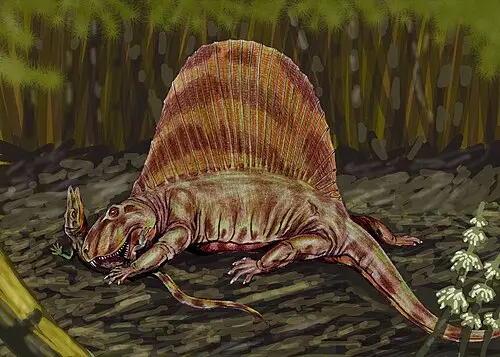
 🎨 Restoration
Restoration: >{{</nowiki> Creator:Dmitry Bogdanov }} · CC BY 3.0 · Wikimedia Commons Source
Life restorations are artistic reconstructions based on fossil evidence; true coloration and soft-tissue details remain uncertain.
Dimetrodon
Dimetrodon limbatus (Dimetrodon · Dimetrodon)
Known only from fossils. The IUCN Red List assesses only species extant since 1500 CE, so fossil taxa are not assigned a category.
💡 Everyday Comparisons for Size, Mass & Speed
- 💡 Although it is often depicted as a dinosaur in movies and toys, it actually belongs to a lineage closer to mammals than to dinosaurs (as explained by Britannica and UCMP).
- 💡 The 3.5 m body length of the largest species in the genus is about 3/4 of the length of a passenger car (about 4.5 m) (Comparison, genus-level value).
Reference standards: coach bus ~12 m, mid-size car ~4.9 m, compact car ~1 t, basketball hoop 3.05 m, credit card 8.56 cm.
📖 1. Overview
Dimetrodon limbatus (genus Dimetrodon) was an Early Permian synapsid (a reptile-like animal closer to the mammalian lineage) with a large sail on its back. It was not a dinosaur and lived long before dinosaurs appeared.
🦴 2. Anatomy & Morphology
Long bony spines rising from its backbones appear to have been connected by a membrane rich in blood vessels to form the sail. The largest species in the genus exceeded 3.5 m in body length.
🔍 3. Fossil Record & Paleoecology
As a carnivore, it represents the land fauna of the Early Permian. It is one of the most common fossils in strata of Texas and Oklahoma, and studies show that smaller species had smaller sails relative to their body size.
🇰🇷 4. Connection to Korea
No direct record connecting this species to Korea has been found.
📚 Sources & References
- • Fossil taxon — the IUCN Red List assesses only species living or extinct since 1500
- • paleobiodb.org — basicTaxonInfo
- • wikidata.org — Q25434740
- • commons.wikimedia.org — File:Dimetr incis22DB.jpg
- • britannica.com — Dimetrodon
- • ucmp.berkeley.edu — pelycosaurs.html
- • nature.com — s41598-026-52199-y
- • Silhouette: PhyloPic — Alessio Ciaffi · CC BY 4.0 (Congeneric silhouette — Dimetrodon)
Recorded dimensions are widely cited representative estimates from public literature and may vary by study or specimen.