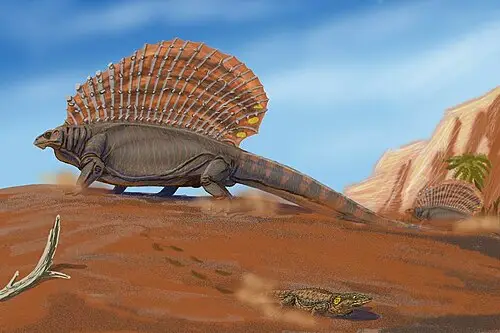
 🎨 Restoration
Restoration: ДиБгд at Russian Wikipedia · Public domain · Wikimedia Commons Source
Life restorations are artistic reconstructions based on fossil evidence; true coloration and soft-tissue details remain uncertain.
Edaphosaurus
Edaphosaurus pogonias (Edaphosaurus · Edaphosaurus)
Known only from fossils. The IUCN Red List assesses only species extant since 1500 CE, so fossil taxa are not assigned a category.
💡 Everyday Comparisons for Size, Mass & Speed
- 💡 The shape of the sail spines with crossbars attached can be compared to a laundry drying rack lined with horizontal bars (Comparison).
- 💡 Just like an automotive wind-tunnel test, researchers placed a model of the sail in a wind tunnel and measured heat loss to test whether the crossbars aided cooling.
Reference standards: coach bus ~12 m, mid-size car ~4.9 m, compact car ~1 t, basketball hoop 3.05 m, credit card 8.56 cm.
📖 1. Overview
Edaphosaurus pogonias (genus Edaphosaurus) was a herbivorous synapsid (an early animal on the mammalian lineage) with a sail on its back that lived in Texas during the Early Permian. This species is one of the Edaphosaurus species known from the Early Permian of Texas.
🦴 2. Anatomy & Morphology
The neural spines of its backbones grew very long to form a sail, and these spines bore small sideways projections (crossbars). Skulls of the genus Edaphosaurus had similarly shaped teeth with sharp edges well suited for cutting tough plants (based on studies of the congeneric E. boanerges).
🔍 3. Fossil Record & Paleoecology
Studies of the same genus suggest that it cut tough ground plants with its front teeth and crushed them with tooth plates on the palate and lower jaw. Wind-tunnel experiments suggest that the crossbars on the sail scattered airflow to cool heat effectively, so the sail may have been used for thermoregulation.
🇰🇷 4. Connection to Korea
No direct record connecting this species to Korea has been found.
📚 Sources & References
- • Fossil taxon — the IUCN Red List assesses only species living or extinct since 1500
- • paleobiodb.org — basicTaxonInfo
- • wikidata.org — Q20717873
- • palass.org — 566
- • resolve.cambridge.org — FB6D3FC9BC9EB6D0A9D3A66A196E5CB4
- • palass.org — article pp573-590
- • Silhouette: PhyloPic — Matt Celeskey · CC BY 3.0
Recorded dimensions are widely cited representative estimates from public literature and may vary by study or specimen.