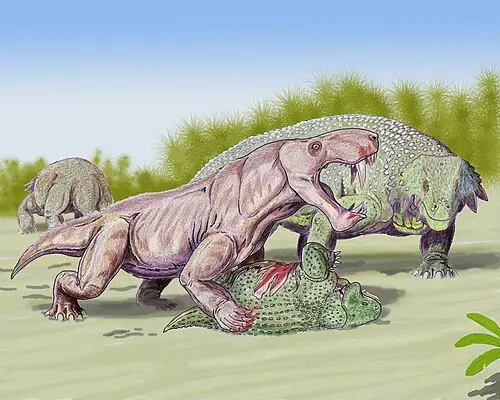
 🎨 Restoration
Restoration: Dmitry Bogdanov · CC BY 3.0 · Wikimedia Commons Source
Life restorations are artistic reconstructions based on fossil evidence; true coloration and soft-tissue details remain uncertain.
Inostrancevia
Inostrancevia alexandri (Inostrancevia · Inostrancevia)
Known only from fossils. The IUCN Red List assesses only species extant since 1500 CE, so fossil taxa are not assigned a category.
💡 Everyday Comparisons for Size, Mass & Speed
- 💡 Its canine tooth shares the same name as the canine teeth of dogs and cats, and in this animal those teeth were long like sabers (Comparison).
- 💡 Excavations at Sokolki in Russia began in the 1890s, thanks to which this animal is counted as the best-known gorgonopsian in the Northern Hemisphere.
Reference standards: coach bus ~12 m, mid-size car ~4.9 m, compact car ~1 t, basketball hoop 3.05 m, credit card 8.56 cm.
📖 1. Overview
Inostrancevia alexandri (genus Inostrancevia) was a gorgonopsian (saber-toothed carnivorous therapsid) that lived in Russia during the Late Permian; thanks to its huge size, it is one of the most famous Permian animals. It is the best-known gorgonopsian of the Northern Hemisphere.
🦴 2. Anatomy & Morphology
Gorgonopsians were carnivores with large saber-shaped canine teeth, and this species had a massive build comparable only to Rubidgea of Africa. Rows of large openings in the bones of the palate are a characteristic feature of Russian gorgonopsians.
🔍 3. Fossil Record & Paleoecology
It belonged to the top predator group on land at the time. Beginning in the 1890s, V. P. Amalitzky conducted large-scale excavations at Sokolki along the Northern Dvina River and collected many Late Permian gorgonopsian fossils, and this species was described as a new species in 1922.
🇰🇷 4. Connection to Korea
No direct record connecting this species to Korea has been found.
📚 Sources & References
- • Fossil taxon — the IUCN Red List assesses only species living or extinct since 1500
- • paleobiodb.org — basicTaxonInfo
- • wikidata.org — Q124482300
- • commons.wikimedia.org — File:Inostrancevia 4DB.jpg
- • pmc.ncbi.nlm.nih.gov — PMC5995105
- • Silhouette: PhyloPic — Will Toosey · CC BY 4.0
Recorded dimensions are widely cited representative estimates from public literature and may vary by study or specimen.