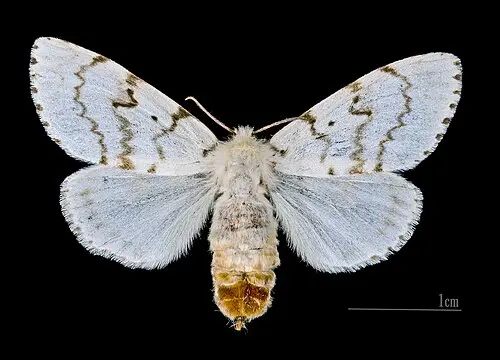
 📸 Photo
Photo: Didier Descouens · CC BY-SA 4.0 · Wikimedia Commons Source
Spongy moth
Lymantria dispar (Spongy moth · マイマイガ)
Not Evaluated (NE) on the IUCN Red List yet.
💡 Everyday Comparisons for Size, Mass & Speed
- 💡 A maximum wingspan of 6.2 cm is slightly longer than two Korean 500-won coins (2.65 cm) placed side by side (5.3 cm) (Comparison).
- 💡 The caterpillars eat the leaves of over 500 tree species, including oaks, and also live on urban and suburban trees. ADW notes that leaf defoliation can also benefit humans by opening forest canopies and thinning overcrowded yard trees.
Reference standards: coach bus ~12 m, mid-size car ~4.9 m, compact car ~1 t, basketball hoop 3.05 m, credit card 8.56 cm.
📖 1. Overview
The spongy moth is a moth whose caterpillars feed on tree leaves, living in temperate forests and wooded cities and suburbs. In Korea, a small population on Soheuksando Island in Jeollanam-do is recorded separately from mainland individuals.
🦴 2. Anatomy & Morphology
Males have a light brown body, dark brown wings with black bands, and feathery antennae, while females are slightly larger and mostly white. The body length is 15–35 mm and the wingspan is 37–62 mm (ADW).
🔍 3. Ecology & Behavior
Only the caterpillars feed on the leaves of over 500 species of trees and shrubs, while adults have underdeveloped mouthparts and do not eat. A female lays about 1,000 eggs a year on tree trunks and branches, and the eggs hatch 8–9 months later.
🇰🇷 4. Connection to Korea
Individuals on Soheuksando Island in Jeollanam-do are noticeably smaller than Korean mainland individuals, with a wingspan of 47–48 mm and a pale wing center (National List of Species of Korea).
📚 Sources & References
- • IUCN Red List: not evaluated (NE) — cross-checked with the Wikidata conservation-status entry
- • catalogueoflife.org — 3WRPC
- • 국가생물종목록(국립생물자원관) ktsn 120000032712 — https://species.nibr.go.kr/home/mainHome.do?cont_link=009&subMenu=009002&contCd=009002&ktsn=120000032712
- • wikidata.org — Q45532
- • commons.wikimedia.org — File:Lymantria dispar MHNT.CUT.2012.0.357 Claix (Isère) Fema
- • animaldiversity.org — Lymantria dispar
- • species.nibr.go.kr — mainHome.do
Recorded dimensions are widely cited representative estimates from public literature and may vary by study or specimen.