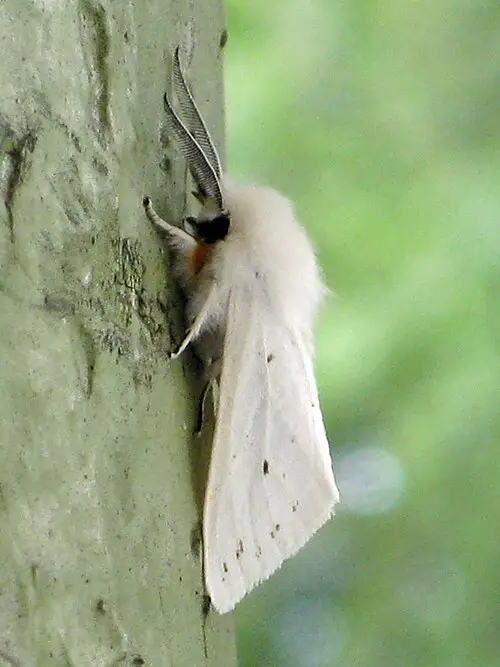
 📸 Photo
Photo: TampAGS , for AGS Media · CC BY-SA 3.0 · Wikimedia Commons Source
Fall webworm
Hyphantria cunea (Fall webworm · アメリカシロヒトリ)
Not Evaluated (NE) on the IUCN Red List yet.
💡 Everyday Comparisons for Size, Mass & Speed
- 💡 Its wingspan of 2.8–3.8 cm is slightly larger than the diameter of a Korean 500-won coin (2.65 cm) (Comparison).
- 💡 Feeding on the leaves of familiar trees such as plane trees, cherry trees, and apple trees, it damages urban trees and orchards and lives mainly in artificial environments (National List of Species of Korea).
Reference standards: coach bus ~12 m, mid-size car ~4.9 m, compact car ~1 t, basketball hoop 3.05 m, credit card 8.56 cm.
📖 1. Overview
The fall webworm is a moth native to North America that is known to have entered Korea in 1957 and spread nationwide. Its caterpillars feed on over 160 tree species—including plane trees, cherry trees, and apple trees—and sometimes cause heavy damage.
🦴 2. Anatomy & Morphology
Its wingspan is 28–38 mm, and both forewings and hindwings are white with scattered black spots. Caterpillars have a black head with a yellow or green body in the north, and an orange or red head with a yellow or light brown body in the south (ADW).
🔍 3. Ecology & Behavior
Adults appear twice a year, around May and from July to early September. Caterpillars are active during the day, spinning white web tents at the tips of branches and eating leaves, while adults are active at night and feed on sap and nectar (ADW).
🇰🇷 4. Connection to Korea
It is distributed in central and southern Korea, with no collection records from offshore islands. After entering Korea in 1957 and spreading nationwide, it lives mainly in artificial environments (National List of Species of Korea).
📚 Sources & References
- • IUCN Red List: not evaluated (NE) — cross-checked with the Wikidata conservation-status entry
- • catalogueoflife.org — 935C8
- • 국가생물종목록(국립생물자원관) ktsn 120000032636 — https://species.nibr.go.kr/home/mainHome.do?cont_link=009&subMenu=009002&contCd=009002&ktsn=120000032636
- • wikidata.org — Q1333342
- • commons.wikimedia.org — File:Hyphantria cunea, adult.jpg
- • animaldiversity.org — Hyphantria cunea
- • species.nibr.go.kr — mainHome.do
Recorded dimensions are widely cited representative estimates from public literature and may vary by study or specimen.