 📸 Photo
Photo: Didier Descouens · CC BY-SA 4.0 · Wikimedia Commons Source
Garden tiger moth
Arctia caja (Garden tiger moth · ヒトリガ)
Not Evaluated (NE) on the IUCN Red List yet.
🇰🇷 Class II endangered wildlife (Korea)
💡 Everyday Comparisons for Size, Mass & Speed
- 💡 Its maximum wingspan of 86 mm is about 3.2 times the diameter of a 500-won coin (26.5 mm).
- 💡 Because of its habit of flying toward light, it is attracted to and disrupted by nighttime lighting such as streetlights and signs, illustrating the impact of urban night lighting on insects.
Reference standards: coach bus ~12 m, mid-size car ~4.9 m, compact car ~1 t, basketball hoop 3.05 m, credit card 8.56 cm.
📖 1. Overview
The garden tiger moth (Arctia caja) is a large moth inhabiting mountains and fields that has a habit of flying toward lights. It is a Class II Endangered Wildlife species in Korea.
🦴 2. Anatomy & Morphology
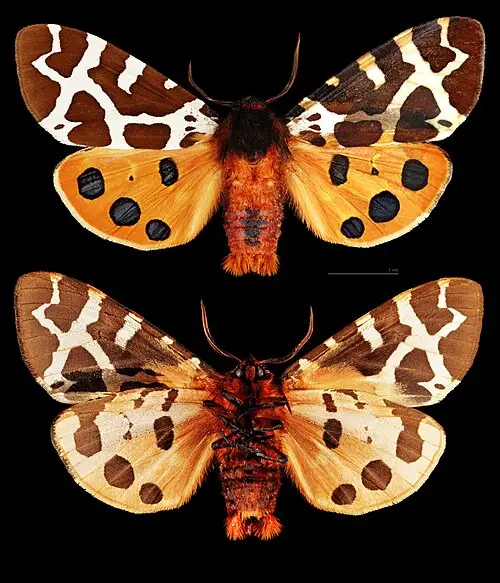
Its wingspan is 58 to 86 mm; the forewings are brown or reddish-brown, and the hindwings have an orange-yellow background with black spots along the outer margin. The male's antennae are bipectinate (comb-like on both sides).
🔍 3. Ecology & Behavior
Adults are active from June to September and are mainly observed in September, overwintering as larvae. The larvae feed on various plants including legumes, roses, mulberries, knotweeds, and nettles.
🇰🇷 4. Connection to Korea
It is a Class II Endangered Wildlife species in Korea. It formerly lived throughout the country but now occurs only locally in certain areas. Disruption and mortality caused by increased nighttime lighting from urbanization are among the reasons for its sharp population decline.
📚 Sources & References
- • 멸종위기 야생생물 Ⅱ급 — 국가생물종목록(국립생물자원관) ktsn 120000032374 — https://species.nibr.go.kr/home/mainHome.do?cont_link=009&subMenu=009002&contCd=009002&ktsn=120000032374
- • IUCN Red List: not evaluated (NE) — cross-checked with the Wikidata conservation-status entry
- • Korean protection status: Class II endangered wildlife (Korea)
- • catalogueoflife.org — 5W3MY
- • 국가생물종목록(국립생물자원관) ktsn 120000032374 — https://species.nibr.go.kr/home/mainHome.do?cont_link=009&subMenu=009002&contCd=009002&ktsn=120000032374
- • wikidata.org — Q674760
- • commons.wikimedia.org — File:(MHNT) Arctia caja caja - Ciechanow Poland - male.jpg
- • nie.re.kr — view.do
- • bok.or.kr — contents.do
- • Silhouette: PhyloPic — Andy Wilson · CC0 1.0
Recorded dimensions are widely cited representative estimates from public literature and may vary by study or specimen.