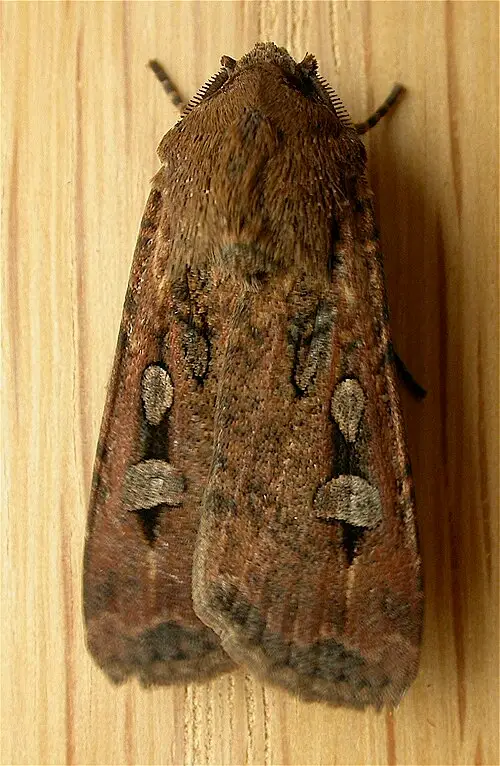
 📸 Photo
Photo: Donald Hobern from Canberra, Australia · CC BY 2.0 · Wikimedia Commons Source
Bogong moth
Agrotis infusa (Bogong moth · Bogong moth)
💡 Everyday Comparisons for Size, Mass & Speed
- 💡 The 5 cm size listed by the museum is close to the length of two Korean 500-won coins (2.65 cm each) placed side by side (5.3 cm) (Comparison, not specified whether wingspan).
- 💡 Aboriginal Australians roasted these moths in hot ashes and mashed them into "moth meat" as an important protein source. In some years, thousands have flown into cities like Sydney and Canberra, causing nuisances at stadiums and in air-conditioning systems (Australian Museum).
Reference standards: coach bus ~12 m, mid-size car ~4.9 m, compact car ~1 t, basketball hoop 3.05 m, credit card 8.56 cm.
📖 1. Overview
The Bogong moth is a noctuid moth famous for its mass spring migrations in southeastern Australia. Its name comes from the Bogong High Plains of the Victorian Alps, and the IUCN assessed it as Endangered (EN) in 2021.
🦴 2. Anatomy & Morphology
The Australian Museum lists its size as 5 cm without specifying whether that is wingspan. Its caterpillar is called the "black cutworm." Adults survive through the summer on fat reserves stored in their bodies.
🔍 3. Ecology & Behavior
In winter, caterpillars grow in inland Australia by feeding on young shoots of broadleaf plants. In spring, adults fly to southern and southeastern highlands to estivate together in rock crevices through summer before migrating north to breed.
🇰🇷 4. Connection to Korea
No direct record connecting this species to Korea has been found.
📚 Sources & References
- • IUCN Red List EN (2021) — https://www.iucnredlist.org/species/190513532/196183274
- • IUCN Red List category EN — latest assessment at iucnredlist.org
- • catalogueoflife.org — 5TTC8
- • iucnredlist.org — 196183274
- • wikidata.org — Q285592
- • commons.wikimedia.org — File:Agrotis infusa.jpg
- • australian.museum — bogong-moth
- • Silhouette: PhyloPic — Dr. F. Nemos · Public Domain Mark 1.0 (Related taxon silhouette — Euclidia glyphica)
Recorded dimensions are widely cited representative estimates from public literature and may vary by study or specimen.