 📸 Photo
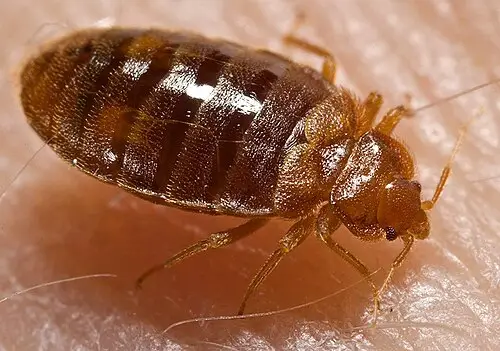
Photo: Content Providers(s): CDC/ Harvard University, Dr. Gary Alpert; Dr. Harold Harlan; Richard Pollack. Photo Credit: Piotr Naskrecki · Public domain · Wikimedia Commons Source
Bed bug
Cimex lectularius (Bed bug · トコジラミ)
Not Evaluated (NE) on the IUCN Red List yet.
💡 Everyday Comparisons for Size, Mass & Speed
- 💡 The adult size of 5–6 mm is compared by the Korea Disease Control and Prevention Agency to an apple seed.
- 💡 Because it hides in bed or mattress crevices and bites while people sleep, it causes itching; there is no record of it transmitting disease, but scratching can lead to secondary skin infections (Korea Disease Control and Prevention Agency).
Reference standards: coach bus ~12 m, mid-size car ~4.9 m, compact car ~1 t, basketball hoop 3.05 m, credit card 8.56 cm.
📖 1. Overview
The bed bug is a small insect that sucks human blood, hiding in crevices during the day and coming out at night to bite people.
🦴 2. Anatomy & Morphology
The adult is a flat, dark brown oval about 5–6 mm long and wingless. It undergoes incomplete metamorphosis, passing from egg through 5 nymph stages to reach adulthood.
🔍 3. Ecology & Behavior
It hides in cracks of furniture or bedroom walls during the day and feeds on blood at night, especially before dawn. Both males and females feed once or twice a week, and females lay 2–5 eggs per day at intervals of 2–3 days, totaling about 200 eggs over a lifetime.
🇰🇷 4. Connection to Korea
The Korea Disease Control and Prevention Agency's bed bug information booklet states that 2 species, the bed bug and Bannalgae-bindae (a Korean animal name), are known to be distributed in Korea.
📚 Sources & References
- • IUCN Red List: not evaluated (NE) — cross-checked with the Wikidata conservation-status entry
- • catalogueoflife.org — 7SBMG
- • 국가생물종목록(국립생물자원관) ktsn 120000025553 — https://species.nibr.go.kr/home/mainHome.do?cont_link=009&subMenu=009002&contCd=009002&ktsn=120000025553
- • wikidata.org — Q940337
- • commons.wikimedia.org — File:Bed bug, Cimex lectularius.jpg
- • kdca.go.kr — download.do
- • cdc.gov — index.html
- • Silhouette: PhyloPic — Ludwik Gąsiorowski · CC0 1.0
Recorded dimensions are widely cited representative estimates from public literature and may vary by study or specimen.