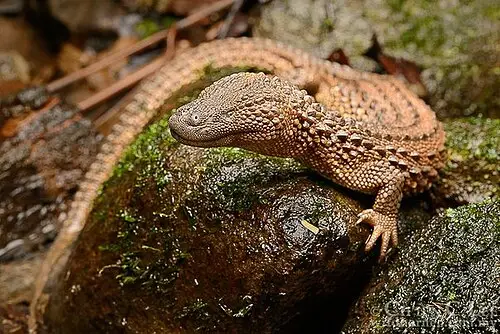
 📸 Photo
Photo: Chien C. Lee, Wild Borneo Photography · CC BY-SA 4.0 · Wikimedia Commons Source
Borneo Earless Monitor
Lanthanotus borneensis (Borneo Earless Monitor · ミミナシオオトカゲ)
💡 Everyday Comparisons for Size, Mass & Speed
- 💡 A snout-to-vent length of about 20 cm is about 2/3 of a 30 cm ruler, and a weight of about 108 g equals roughly two chicken eggs (Comparison).
- 💡 Individuals bound for the black-market pet trade have been seized at Indonesian airports and handed over to research facilities (research paper from Indonesia's BRIN museum).
Reference standards: coach bus ~12 m, mid-size car ~4.9 m, compact car ~1 t, basketball hoop 3.05 m, credit card 8.56 cm.
Site-computed relative index from recorded values; not a formal scientific metric.
📖 1. Overview
The Borneo Earless Monitor is a rare lizard living only in the lowlands of Borneo, and is the sole species in the family Lanthanotidae.
🦴 2. Anatomy & Morphology
True to its name, it lacks external ear openings and has an elongated body; adult snout-to-vent length is 16.5–20.1 cm, and body weight ranges from several dozen grams to just over 100 g.
🔍 3. Ecology & Behavior
Active at night and secretive, it spends long periods resting almost motionless. In captivity it ate earthworms more readily than shrimp meat, with feeding activity increasing in the afternoon and at night.
🇰🇷 4. Connection to Korea
No direct record connecting this species to Korea has been found.
📚 Sources & References
- • IUCN Red List EN (2021) — https://www.iucnredlist.org/species/102342572/102342580
- • IUCN Red List category EN — latest assessment at iucnredlist.org
- • catalogueoflife.org — 3S7W2
- • iucnredlist.org — 102342580
- • wikidata.org — Q904780
- • commons.wikimedia.org — File:Real Lanthanotus borneensis.jpg
- • ejournal.brin.go.id — 7102
- • threatenedtaxa.org — 1445
- • Silhouette: PhyloPic — François-Louis PELISSIER · CC0 1.0
Recorded dimensions are widely cited representative estimates from public literature and may vary by study or specimen.