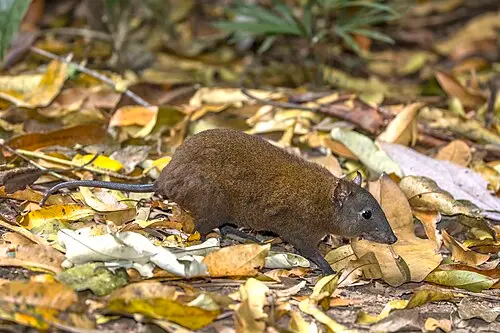
 📸 Photo
Photo: Charles J. Sharp · CC BY-SA 4.0 · Wikimedia Commons Source
Musky Rat Kangaroo
Hypsiprymnodon moschatus (Musky Rat Kangaroo · Musky Rat Kangaroo)
💡 Everyday Comparisons for Size, Mass & Speed
- 💡 Its average weight of 500 g equals a 500 mL bottle of water, and its maximum body length of 34.1 cm is slightly longer than the long side of an A4 sheet of paper (29.7 cm) (Comparison).
- 💡 It uses its tail to gather dried grass, ferns, and lichens to build a nest among vine thickets or between the plank buttresses of large trees.
Reference standards: coach bus ~12 m, mid-size car ~4.9 m, compact car ~1 t, basketball hoop 3.05 m, credit card 8.56 cm.
Site-computed relative index from recorded values; not a formal scientific metric.
📖 1. Overview
The Musky Rat Kangaroo is a small macropod living in lakeside and streamside thickets of Australian tropical rainforests; it is diurnal and very shy.
🦴 2. Anatomy & Morphology
It has reddish-brown or rusty-gray fur with a paler belly, and a scaly, hairless tail like that of an opossum. Its ears are also hairless and thin, and its forelimbs and hindlimbs are more similar in size than in other macropods.
🔍 3. Ecology & Behavior
Unlike other macropods, it feeds mainly on insects and also eats worms, tuberous roots, and palm berries. Instead of hopping, it runs on all four limbs, and females usually give birth to two young.
🇰🇷 4. Connection to Korea
No direct record connecting this species to Korea has been found.
📚 Sources & References
- • IUCN Red List LC (2016) — https://www.iucnredlist.org/species/40559/21963734
- • IUCN Red List category LC — latest assessment at iucnredlist.org
- • mammaldiversity.org — 1000251
- • iucnredlist.org — 21963734
- • wikidata.org — Q652159
- • commons.wikimedia.org — File:Musky rat-kangaroo (Hypsiprymnodon moschatus) Atherton.
- • animaldiversity.org — Hypsiprymnodon moschatus
Recorded dimensions are widely cited representative estimates from public literature and may vary by study or specimen.