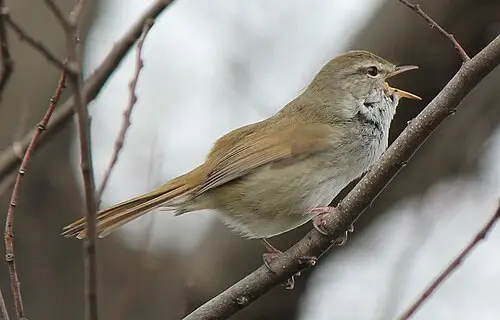
 📸 Photo
Photo: Alpsdake · CC BY-SA 3.0 · Wikimedia Commons Source
Japanese Bush Warbler
Horornis diphone (Japanese Bush Warbler · ウグイス)
💡 Everyday Comparisons for Size, Mass & Speed
- 💡 Its total length of about 15 cm is similar to a ballpoint pen (about 14 cm) (Comparison).
- 💡 In Japan, its "ho-hokekyo" song has long made it a subject of poetry, and it was also kept in homes (Ministry of the Environment of Japan).
- 💡 On the Korean Peninsula, it breeds around bamboo groves along the southern coast, islands, and southern interior (Korea National Park Service).
Reference standards: coach bus ~12 m, mid-size car ~4.9 m, compact car ~1 t, basketball hoop 3.05 m, credit card 8.56 cm.
📖 1. Overview
The Japanese Bush Warbler is a bush warbler that breeds along the southern coast and southern interior of the Korean Peninsula, showing a stronger tendency to stay in one place than the Manchurian Bush Warbler.
🦴 2. Anatomy & Morphology
According to Ministry of the Environment of Japan materials, its total length is about 14–15.5 cm, and males are slightly larger than females. Its body is greenish-brown overall with a pale brown supercilium, and it has 10 tail feathers.
🔍 3. Ecology & Behavior
It mainly eats insects and spiders and sings "ho-hokekyo." In the southern Korean Peninsula it breeds in arrow bamboo, bamboo groves, or evergreen broadleaf forests, and on Sobaeksan it also breeds near the treeline mixed with royal azaleas and shrubs.
🇰🇷 4. Connection to Korea
According to a survey by the Korea National Park Service Migratory Bird Research Center, breeding has been confirmed not only along the southern coast but also in the southern interior, with the northern breeding limit around Yeonhwabong Peak on Sobaeksan.
📚 Sources & References
- • IUCN Red List LC (2024) — https://www.iucnredlist.org/species/22714380/263842871
- • IUCN Red List category LC — latest assessment at iucnredlist.org
- • doi.org — avilist.v2026
- • iucnredlist.org — 263842871
- • 국가생물종목록(국립생물자원관) ktsn 120000528740 — https://species.nibr.go.kr/home/mainHome.do?cont_link=009&subMenu=009002&contCd=009002&ktsn=120000528740
- • wikidata.org — Q27075456
- • commons.wikimedia.org — File:Cettia diphone (crying).JPG
- • biodic.go.jp — Cettia diphone wamei.html
- • knps.or.kr — birdDtl.do
Recorded dimensions are widely cited representative estimates from public literature and may vary by study or specimen.