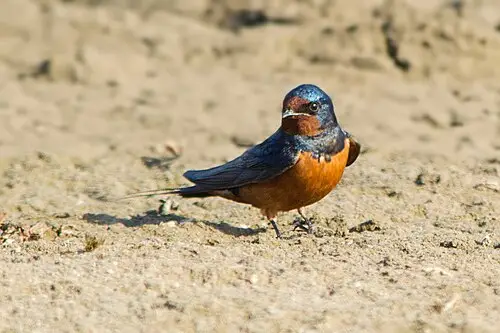
 📸 Photo
Photo: Morhaf Aljanee · CC BY-SA 3.0 · Wikimedia Commons Source
Barn Swallow
Hirundo rustica (Barn Swallow · ツバメ)
💡 Everyday Comparisons for Size, Mass & Speed
- 💡 The Barn Swallow has long been regarded in Korea as a herald of spring (Encyclopedia of Korean Culture).
- 💡 It builds mud nests under the eaves of rural houses and in barns, under bridges, and on docks (ADW).
- 💡 Its weight of about 20 g is roughly the weight of two or three Korean 500-won coins (7.7 g each) (Comparison).
Reference standards: coach bus ~12 m, mid-size car ~4.9 m, compact car ~1 t, basketball hoop 3.05 m, credit card 8.56 cm.
Site-computed relative index from recorded values; not a formal scientific metric.
📖 1. Overview
The Barn Swallow is a summer migratory bird that arrives in spring and builds its nest under the eaves of human houses.
🦴 2. Anatomy & Morphology
Its forehead and throat are reddish, its back is deep blue, and the outer two feathers of its long tail are slender and elongated.
🔍 3. Ecology & Behavior
It catches insects such as flies, grasshoppers, dragonflies, beetles, and moths on the wing, with flying insects making up 99% of its diet. From April to July, it nests under eaves, laying 3–7 eggs and incubating them for 13–18 days.
🇰🇷 4. Connection to Korea
It is a representative summer visitor breeding throughout Korea, and individuals wintering in the southern regions have also been confirmed recently.
📚 Sources & References
- • IUCN Red List LC (2019) — https://www.iucnredlist.org/species/22712252/137668645
- • IUCN Red List category LC — latest assessment at iucnredlist.org
- • doi.org — avilist.v2026
- • iucnredlist.org — 137668645
- • 국가생물종목록(국립생물자원관) ktsn 120000001988 — https://species.nibr.go.kr/home/mainHome.do?cont_link=009&subMenu=009002&contCd=009002&ktsn=120000001988
- • wikidata.org — Q25429
- • commons.wikimedia.org — File:Barn Swallow (95504589).jpeg
- • animaldiversity.org — Hirundo rustica
- • encykorea.aks.ac.kr — E0051288
- • avifauna.hkbws.org.hk — 036500
- • Silhouette: PhyloPic — Matt Wilkins · CC0 1.0
Recorded dimensions are widely cited representative estimates from public literature and may vary by study or specimen.