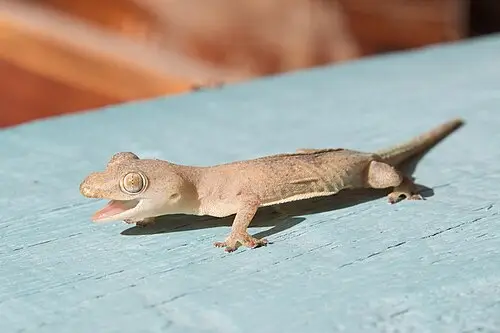
 📸 Photo
Photo: Basile Morin · CC BY 4.0 · Wikimedia Commons Source
Common House Gecko
Hemidactylus frenatus (Common House Gecko · ホオグロヤモリ)
💡 Everyday Comparisons for Size, Mass & Speed
- 💡 By preying on insects drawn to building lights, it also helps control pests in urban areas (benefit to humans noted by ADW).
- 💡 Its maximum length of 150 mm is similar to the length of a ballpoint pen (about 14–15 cm) (Comparison).
Reference standards: coach bus ~12 m, mid-size car ~4.9 m, compact car ~1 t, basketball hoop 3.05 m, credit card 8.56 cm.
📖 1. Overview
The Common House Gecko is a small gecko commonly seen at night near electric lights on houses and buildings in warm regions.
🦴 2. Anatomy & Morphology
Measuring 75–150 mm long, it is grey or light brown with a greenish sheen and a white belly that can look semi-transparent. Its pupils are vertical slits and its eyes are adapted to see well in the dark.
🔍 3. Ecology & Behavior
A nocturnal predator whose diet consists mostly of insects and spiders along with small lizards and nectar, it is strongly territorial, biting rivals and sometimes losing its tail. In the tropics it breeds year-round, and males give a 3–5 syllable call.
🇰🇷 4. Connection to Korea
No direct record connecting this species to Korea has been found.
📚 Sources & References
- • IUCN Red List LC (2021) — https://www.iucnredlist.org/species/99156022
- • IUCN Red List category LC — latest assessment at iucnredlist.org
- • catalogueoflife.org — 6LQ37
- • iucnredlist.org — 99156022
- • wikidata.org — Q1931739
- • commons.wikimedia.org — File:Common House Gecko with open mouth, in Laos.jpg
- • animaldiversity.org — Hemidactylus frenatus
- • Silhouette: PhyloPic — Andy Wilson · CC0 1.0
Recorded dimensions are widely cited representative estimates from public literature and may vary by study or specimen.