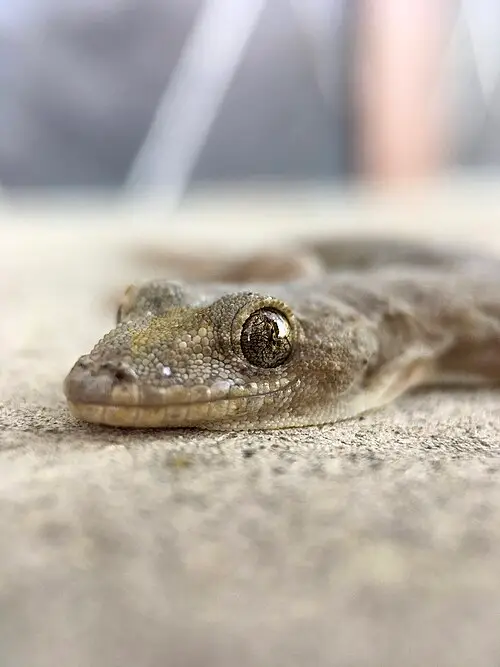
 📸 Photo
Photo: Norio Nomura · CC BY-SA 4.0 · Wikimedia Commons Source
Schlegel's Japanese Gecko
Gekko japonicus (Schlegel's Japanese Gecko · ニホンヤモリ)
💡 Everyday Comparisons for Size, Mass & Speed
- 💡 A body length of 11–12 cm is slightly longer than the long side of a credit card (about 8.6 cm) (Comparison).
- 💡 Living around houses, it preys on insects and spiders indoors and outdoors, and usually lays 2 pure white eggs (National List of Species of Korea).
Reference standards: coach bus ~12 m, mid-size car ~4.9 m, compact car ~1 t, basketball hoop 3.05 m, credit card 8.56 cm.
📖 1. Overview
Schlegel's Japanese Gecko is a small gecko living around houses where it preys on insects and spiders, found in southern Korea and on Jeju Island.
🦴 2. Anatomy & Morphology
Its back is grey or greyish-brown with irregular dark markings, and its belly is white or greyish-white. Its toes have adhesive pads, and if its tail breaks off, it promptly regenerates.
🔍 3. Ecology & Behavior
Living in warm areas and active mainly at night, it eats only live small arthropods, with small spiders being its favorite prey. In summer, females lay a clutch of 2 eggs beneath tree bark or leaves.
🇰🇷 4. Connection to Korea
It is listed as "Domabaembuchi" (Korean name) in the National List of Species of Korea and inhabits southern regions and Jeju Island in Korea.
📚 Sources & References
- • IUCN Red List LC (2019) — https://www.iucnredlist.org/species/96251704/96251724
- • IUCN Red List category LC — latest assessment at iucnredlist.org
- • catalogueoflife.org — 3FH5S
- • iucnredlist.org — 96251724
- • 국가생물종목록(국립생물자원관) ktsn 120000059464 — https://species.nibr.go.kr/home/mainHome.do?cont_link=009&subMenu=009002&contCd=009002&ktsn=120000059464
- • wikidata.org — Q1077651
- • commons.wikimedia.org — File:Gekko japonicus 118467435.jpg
- • species.nibr.go.kr — mainHome.do
- • Silhouette: PhyloPic — Steven Traver · CC0 1.0 (Congeneric silhouette — Gekko vittatus)
Recorded dimensions are widely cited representative estimates from public literature and may vary by study or specimen.