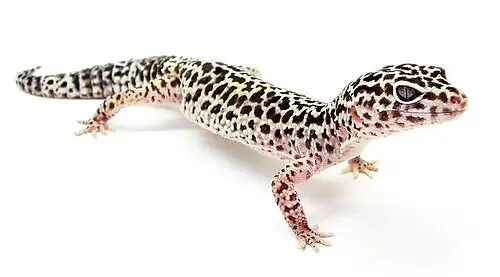
 📸 Photo
Photo: Matt Reinbold · CC BY-SA 2.0 · Wikimedia Commons Source
Common Leopard Gecko
Eublepharis macularius (Common Leopard Gecko · ヒョウモントカゲモドキ)
💡 Everyday Comparisons for Size, Mass & Speed
- 💡 Very popular as a pet, most individuals sold in shops are captive-bred (benefit to humans noted by ADW).
- 💡 With a captive lifespan of about 22 years, keeping one means spending from elementary school entry into one's early 20s together (Comparison).
- 💡 A newly hatched juvenile's length of about 85 mm is almost identical to the long side of a credit card (about 85.6 mm) (Comparison).
Reference standards: coach bus ~12 m, mid-size car ~4.9 m, compact car ~1 t, basketball hoop 3.05 m, credit card 8.56 cm.
📖 1. Overview
The Common Leopard Gecko is a ground-dwelling gecko living in dry deserts and arid grasslands, popular as a pet for its yellow body patterned with black spots.
🦴 2. Anatomy & Morphology
Its ground color is usually yellow with irregular black spots and a white belly. It has movable eyelids, vertical slit pupils, and a segmented tail capable of breaking off.
🔍 3. Ecology & Behavior
Nocturnal in the wild, it preys on scorpions, centipedes, spiders, and beetles, hiding under rocks or in burrows by day. Females usually lay two eggs at a time, which hatch after 45–53 days at 28 degrees, with sex determined by incubation temperature.
🇰🇷 4. Connection to Korea
No direct record connecting this species to Korea has been found.
📚 Sources & References
- • IUCN Red List LC (2021) — https://www.iucnredlist.org/species/164745/1072324
- • IUCN Red List category LC — latest assessment at iucnredlist.org
- • catalogueoflife.org — 3BNV5
- • iucnredlist.org — 1072324
- • wikidata.org — Q256860
- • commons.wikimedia.org — File:Eublepharis macularius1.jpg
- • animaldiversity.org — Eublepharis macularius
- • Silhouette: PhyloPic — Jose Carlos Arenas-Monroy · CC0 1.0 (Congeneric silhouette — Eublepharis turcmenicus)
Recorded dimensions are widely cited representative estimates from public literature and may vary by study or specimen.