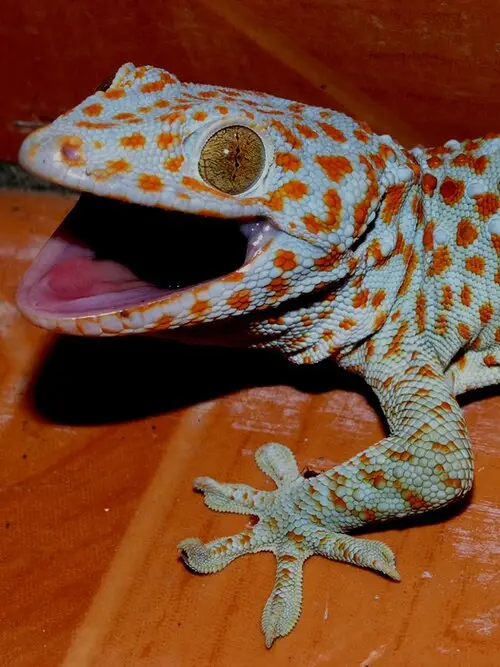
 📸 Photo
Photo: Nick Hobgood · CC BY 2.0 · Wikimedia Commons Source
Tokay Gecko
Gekko gecko (Tokay Gecko · トッケイヤモリ)
💡 Everyday Comparisons for Size, Mass & Speed
- 💡 A male's length of 40 cm is about a handspan longer than a 30 cm school ruler (Comparison).
- 💡 The Smithsonian notes that it enters houses to catch insects, and ADW notes that people also keep it in homes as a pet.
- 💡 At the Smithsonian's National Zoo, it is fed crickets, cockroaches, and mealworms.
Reference standards: coach bus ~12 m, mid-size car ~4.9 m, compact car ~1 t, basketball hoop 3.05 m, credit card 8.56 cm.
📖 1. Overview
The Tokay Gecko is a large gecko living in forests and houses across Southeast Asia and southern China that calls loudly with a "to-kay" sound.
🦴 2. Anatomy & Morphology
Males measure 35–40 cm, females 20–30 cm, and hatchlings 5–7.5 cm. Its toe pads cling to walls with remarkable strength.
🔍 3. Ecology & Behavior
Arboreal, it eats invertebrates such as moths, grasshoppers, cockroaches, crickets, and spiders, and occasionally catches small mice or snakes. Males call loudly "to-kay" to attract mates, and both parents guard the eggs.
🇰🇷 4. Connection to Korea
No direct record connecting this species to Korea has been found.
📚 Sources & References
- • IUCN Red List LC (2019) — https://www.iucnredlist.org/species/195309/2378260
- • IUCN Red List category LC — latest assessment at iucnredlist.org
- • catalogueoflife.org — 3FH5H
- • iucnredlist.org — 2378260
- • wikidata.org — Q331213
- • commons.wikimedia.org — File:Tokay.jpg
- • nationalzoo.si.edu — tokay-gecko
- • animaldiversity.org — Gekko gecko
- • Silhouette: PhyloPic — Birgit Szabo · CC0 1.0
Recorded dimensions are widely cited representative estimates from public literature and may vary by study or specimen.