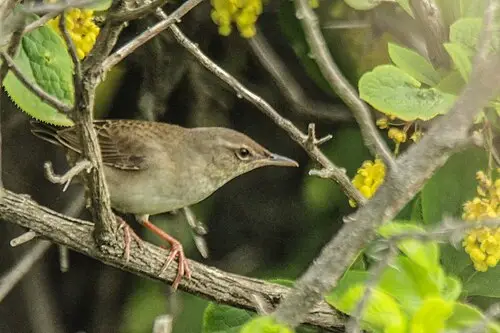
 📸 Photo
Photo: (c) Andrew Bazdyrev, some rights reserved (CC BY) · CC BY 4.0 · Wikimedia Commons Source
Styan's Grasshopper Warbler
Helopsaltes pleskei (Styan's Grasshopper Warbler · ウチヤマセンニュウ)
🇰🇷 Class II endangered wildlife (Korea)
💡 Everyday Comparisons for Size, Mass & Speed
- 💡 In a Japanese study, island-breeding birds were weighed one by one, revealing an average male weight of 22.8 g (Bird Research News).
- 💡 Its weight of 22.8 g is about the weight of three Korean 500-won coins (7.7 g each) (Comparison).
Reference standards: coach bus ~12 m, mid-size car ~4.9 m, compact car ~1 t, basketball hoop 3.05 m, credit card 8.56 cm.
Site-computed relative index from recorded values; not a formal scientific metric.
📖 1. Overview
Styan's Grasshopper Warbler is a small bird that breeds on small offshore islands, including those around the Korean Peninsula, and winters in southern China; it is assessed as Vulnerable (VU) globally.
🦴 2. Anatomy & Morphology
Its upperparts are olive-brown without any reddish tinge, its underparts are grayish-white, and its tail feathers have rounded tips with white edges. Males and females have similar plumage.
🔍 3. Ecology & Behavior
It feeds its chicks soil invertebrates such as woodlice, sandhoppers, and centipedes at first, and later insects such as butterflies, moths, and orthopterans. It lays an average of 3.5 eggs per clutch and incubates them for about 13 days.
🇰🇷 4. Connection to Korea
It is a Class II endangered wildlife species (Korea) in the National List of Species of Korea, with records of breeding on islands off the Korean Peninsula.
📚 Sources & References
- • IUCN Red List LC (2025) — https://www.iucnredlist.org/species/22714674/266418398
- • 멸종위기 야생생물 Ⅱ급 — 국가생물종목록(국립생물자원관) ktsn 120000002032 — https://species.nibr.go.kr/home/mainHome.do?cont_link=009&subMenu=009002&contCd=009002&ktsn=120000002032
- • IUCN Red List category LC — latest assessment at iucnredlist.org
- • Korean protection status: Class II endangered wildlife (Korea)
- • doi.org — avilist.v2026
- • iucnredlist.org — 266418398
- • 국가생물종목록(국립생물자원관) ktsn 120000002032 — https://species.nibr.go.kr/home/mainHome.do?cont_link=009&subMenu=009002&contCd=009002&ktsn=120000002032
- • wikidata.org — Q62168788
- • commons.wikimedia.org — File:Helopsaltes pleskei, Vladivostok 308044743.jpg
- • avifauna.hkbws.org.hk — 041800
- • bird-research.jp — uchiyama.pdf
- • species.nibr.go.kr — general-search
- • Silhouette: PhyloPic — Afsarnayakkan · CC BY 4.0 (Related taxon silhouette — Locustella naevia)
Recorded dimensions are widely cited representative estimates from public literature and may vary by study or specimen.