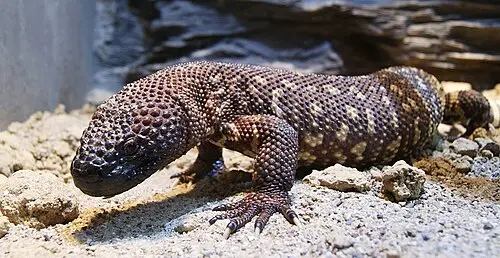
 📸 Photo
Photo: Danny S. · CC BY-SA 4.0 · Wikimedia Commons Source
Mexican Beaded Lizard
Heloderma horridum (Mexican Beaded Lizard · メキシコドクトカゲ)
💡 Everyday Comparisons for Size, Mass & Speed
- 💡 A length of 90 cm is similar to a baseball bat (about 85 cm), and a weight of 4 kg equals a 4 kg bag of rice (Comparison).
- 💡 Some individuals are sold in the pet trade (University of Michigan Museum of Zoology ADW).
Reference standards: coach bus ~12 m, mid-size car ~4.9 m, compact car ~1 t, basketball hoop 3.05 m, credit card 8.56 cm.
Site-computed relative index from recorded values; not a formal scientific metric.
📖 1. Overview
The Mexican Beaded Lizard is a venomous lizard living in semi-arid rocky terrain of Mexico, hiding in burrows by day and active at night.
🦴 2. Anatomy & Morphology
It has a cylindrical body, a thick tail, a wide, flat head, and short, sturdy legs. Yellow spots are scattered along the neck and tail over bead-like black and brown scales.
🔍 3. Ecology & Behavior
It eats small mammals, birds, lizards, frogs, insects, and bird and reptile eggs, living off fat stored in its tail when food is scarce. Its venom is used both to subdue prey and to fend off predators such as humans and coyotes.
🇰🇷 4. Connection to Korea
No direct record connecting this species to Korea has been found.
📚 Sources & References
- • IUCN Red List LC (2021) — https://www.iucnredlist.org/species/181152163/181152647
- • IUCN Red List category LC — latest assessment at iucnredlist.org
- • catalogueoflife.org — 3KGXY
- • iucnredlist.org — 181152647
- • wikidata.org — Q301084
- • commons.wikimedia.org — File:Heloderma horridum Löbbecke Museum.jpg
- • animaldiversity.org — Heloderma horridum
- • Silhouette: PhyloPic — Nicolas Mongiardino Koch · CC0 1.0 (Congeneric silhouette — Heloderma suspectum)
Recorded dimensions are widely cited representative estimates from public literature and may vary by study or specimen.