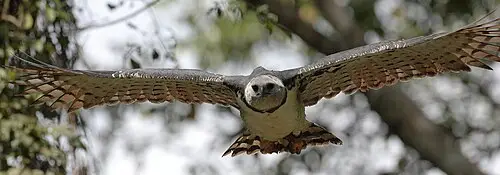
 📸 Photo
Photo: Mdf · CC BY-SA 3.0 · Wikimedia Commons Source
Harpy Eagle
Harpia harpyja (Harpy Eagle · オウギワシ)
💡 Everyday Comparisons for Size, Mass & Speed
- 💡 Its 12.5 cm talons are about two-thirds (2/3) the length of a new pencil (about 17.5 cm) (Comparison).
- 💡 According to ADW, Indigenous hunters sometimes use this bird in ceremonial rituals, and it is the symbol bird of Panama and the state of Paraná, Brazil.
Reference standards: coach bus ~12 m, mid-size car ~4.9 m, compact car ~1 t, basketball hoop 3.05 m, credit card 8.56 cm.
Site-computed relative index from recorded values; not a formal scientific metric.
📖 1. Overview
The Harpy Eagle is one of the largest eagles, living in tropical lowland rainforests. It is the national bird of Panama and the state bird of Paraná in Brazil.
🦴 2. Anatomy & Morphology
Its body length is 89–102 cm with a wingspan of about 2 m, and its talons reach 12.5 cm in length. Females are larger, with a slate-black upper body and light gray breast and belly marked with horizontal black bars.
🔍 3. Ecology & Behavior
It mainly hunts sloths and monkeys, and also catches lizards, birds, small rodents, and occasionally small deer. Pairs bond for life and build their nests in tall trees high in the forest canopy.
🇰🇷 4. Connection to Korea
No direct record connecting this species to Korea has been found.
📚 Sources & References
- • IUCN Red List VU (2021) — https://www.iucnredlist.org/species/22695998/197957213
- • IUCN Red List category VU — latest assessment at iucnredlist.org
- • doi.org — avilist.v2026
- • iucnredlist.org — 197957213
- • wikidata.org — Q53745
- • commons.wikimedia.org — File:Harpia-harpyja-001.jpg
- • animaldiversity.org — Harpia harpyja
- • Silhouette: PhyloPic — Robert Cooke · CC0 1.0 (Related taxon silhouette — Accipitridae)
Recorded dimensions are widely cited representative estimates from public literature and may vary by study or specimen.