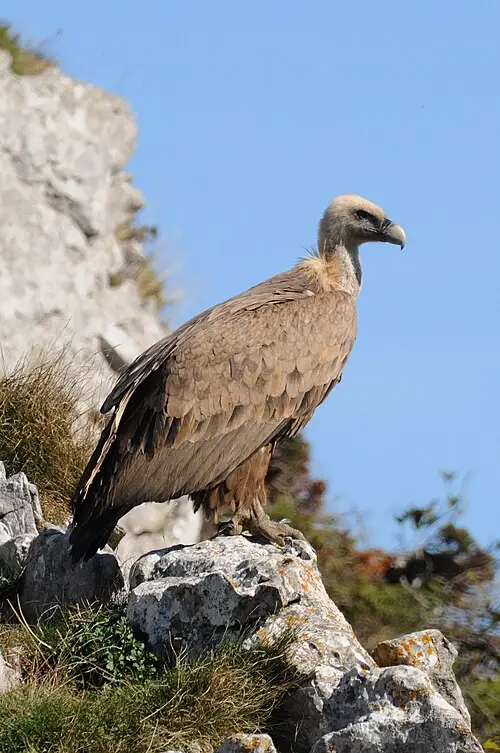
 📸 Photo
Photo: Markel Olano, goierritarra1 · CC BY-SA 2.0 · Wikimedia Commons Source
Griffon Vulture
Gyps fulvus (Griffon Vulture · シロエリハゲワシ)
💡 Everyday Comparisons for Size, Mass & Speed
- 💡 Its wingspan of 2.8 m is more than one and a half times the width of a passenger car (about 1.8 m) (Comparison).
- 💡 According to Naturalis, it feeds on the soft tissues of livestock such as cattle, horses, donkeys, goats, and sheep as well as deer and foxes.
Reference standards: coach bus ~12 m, mid-size car ~4.9 m, compact car ~1 t, basketball hoop 3.05 m, credit card 8.56 cm.
Site-computed relative index from recorded values; not a formal scientific metric.
📖 1. Overview
The Griffon Vulture is a large vulture that breeds and roosts on mountains and tall cliffs. In flight, it soars with its wings held in a shallow V-shape.
🦴 2. Anatomy & Morphology
Its length is 95–105 cm and its wingspan reaches 255–280 cm. It is mostly silent in flight, uttering low growls or hisses when gathered in flocks.
🔍 3. Ecology & Behavior
It feeds almost exclusively on carrion, eating the soft tissues of medium to large mammals—fresh or decaying—such as cattle, horses, donkeys, goats, sheep, deer, and foxes. It soars over wide mountain and arid regions in search of food.
🇰🇷 4. Connection to Korea
No direct record connecting this species to Korea has been found.
📚 Sources & References
- • IUCN Red List LC (2021) — https://www.iucnredlist.org/species/22695219/157719127
- • IUCN Red List category LC — latest assessment at iucnredlist.org
- • doi.org — avilist.v2026
- • iucnredlist.org — 157719127
- • wikidata.org — Q177856
- • commons.wikimedia.org — File:Gyps fulvus -Basque Country-8.jpg
- • bris.linnaeus.naturalis.nl — taxon.php
- • Silhouette: PhyloPic — Kaija Gahm · CC BY 4.0
Recorded dimensions are widely cited representative estimates from public literature and may vary by study or specimen.