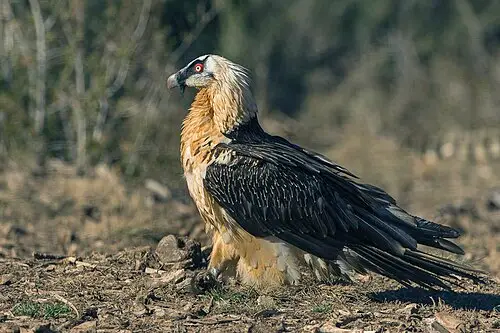
 📸 Photo
Photo: Francesco Veronesi from Italy · CC BY-SA 2.0 · Wikimedia Commons Source
Bearded Vulture
Gypaetus barbatus (Bearded Vulture · ヒゲワシ)
💡 Everyday Comparisons for Size, Mass & Speed
- 💡 Its wingspan of 2.83 m is longer than the height of a room door (about 2 m) (Comparison).
- 💡 According to ADW, it acts as a scavenger that removes carcasses and helps prevent the spread of disease.
Reference standards: coach bus ~12 m, mid-size car ~4.9 m, compact car ~1 t, basketball hoop 3.05 m, credit card 8.56 cm.
Site-computed relative index from recorded values; not a formal scientific metric.
📖 1. Overview
The Bearded Vulture is a very large vulture that feeds mainly on bones and lives on rocky cliffs in high mountains. Its name comes from the black bristles extending from beside its eyes to beneath its bill like a beard.
🦴 2. Anatomy & Morphology
Its head is gray or yellowish, its underparts are yellowish-brown, and its upperparts and tail are black. Its wings are long and narrow, and its tail is wedge-shaped.
🔍 3. Ecology & Behavior
It mainly eats carrion and bones of dead animals, dropping bones from high in the air to extract marrow from the shattered pieces. Its stomach acid is strong enough to digest bone within 24 hours.
🇰🇷 4. Connection to Korea
The National List of Species of Korea notes records of it being found in Hamgyeongnam-do and Gangwon-do.
📚 Sources & References
- • IUCN Red List NT (2021) — https://www.iucnredlist.org/species/22695174/154813652
- • IUCN Red List category NT — latest assessment at iucnredlist.org
- • doi.org — avilist.v2026
- • iucnredlist.org — 154813652
- • 국가생물종목록(국립생물자원관) ktsn 120000001590 — https://species.nibr.go.kr/home/mainHome.do?cont_link=009&subMenu=009002&contCd=009002&ktsn=120000001590
- • wikidata.org — Q126167
- • commons.wikimedia.org — File:Bearded Vulture - Catalan Pyrenees - Spain (25098398432
- • animaldiversity.org — Gypaetus barbatus
- • species.nibr.go.kr — mainHome.do
- • Silhouette: PhyloPic — Shyamal · CC BY 3.0
Recorded dimensions are widely cited representative estimates from public literature and may vary by study or specimen.