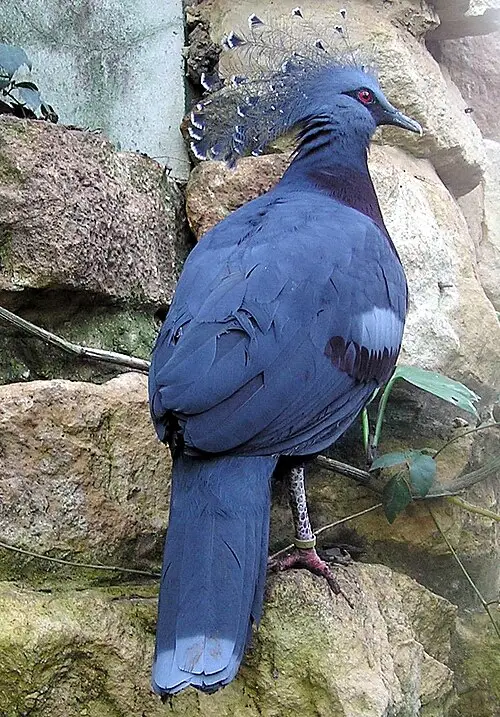
 📸 Photo
Photo: Arpingstone · Public domain · Wikimedia Commons Source
Victoria Crowned Pigeon
Goura victoria (Victoria Crowned Pigeon · オウギバト)
💡 Everyday Comparisons for Size, Mass & Speed
- 💡 Its maximum body length of 74 cm is slightly taller than a standard desk height (about 70 cm), and its maximum weight of 3.5 kg is heavier than a 3 kg bag of rice (Comparison).
- 💡 The Toronto Zoo describes this bird as being "about the size of a large chicken."
- 💡 Because of its large size, it is a favored game bird hunted by Indigenous peoples of New Guinea, which is one of the reasons for its Near Threatened status.
Reference standards: coach bus ~12 m, mid-size car ~4.9 m, compact car ~1 t, basketball hoop 3.05 m, credit card 8.56 cm.
Site-computed relative index from recorded values; not a formal scientific metric.
📖 1. Overview
The Victoria Crowned Pigeon is one of the largest pigeons, living in the forests of New Guinea and spending most of its time foraging on the ground. Its numbers have declined due to hunting and habitat loss, placing it at Near Threatened.
🦴 2. Anatomy & Morphology
Its body is dark bluish-gray with a fan-shaped crest on the head tipped in white and purple, a purple breast, and a steel-gray belly. It has red eyes, mottled brown-and-white long legs, and orange feet, and unlike other pigeons it has 16 tail feathers and lacks an oil gland and gallbladder.
🔍 3. Ecology & Behavior
It mainly eats fallen fruits on the ground along with berries, seeds, and insects, forming groups of 2–10 birds. It flies up into trees only when threatened or to roost at night. Monogamous pairs lay a single egg, and both parents produce "pigeon milk" in their crops to feed the chick.
🇰🇷 4. Connection to Korea
No direct record connecting this species to Korea has been found.
📚 Sources & References
- • IUCN Red List NT (2021) — https://www.iucnredlist.org/species/22691874/181555952
- • IUCN Red List category NT — latest assessment at iucnredlist.org
- • doi.org — avilist.v2026
- • iucnredlist.org — 181555952
- • wikidata.org — Q579213
- • commons.wikimedia.org — File:Bristol.zoo.victoria.crowned.pigeon.arp.jpg
- • artis.nl — victoria-crowned-pigeon
- • torontozoo.com — Victoria crowned pigeon
- • louisvillezoo.org — pigeon-crowned
- • Silhouette: PhyloPic — RS · CC0 1.0 (Related taxon silhouette — Columbidae)
Recorded dimensions are widely cited representative estimates from public literature and may vary by study or specimen.