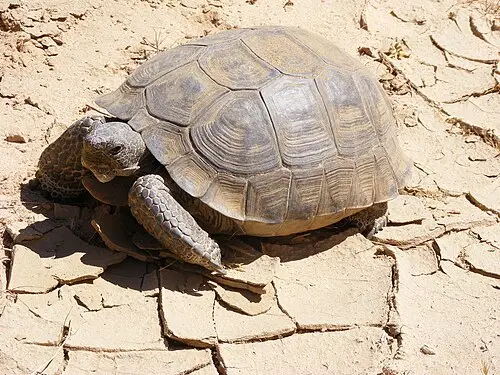
 📸 Photo
Photo: Tigerhawkvok · CC BY-SA 3.0 · Wikimedia Commons Source
Agassiz's Desert Tortoise
Gopherus agassizii (Agassiz's Desert Tortoise · サバクゴファーガメ)
💡 Everyday Comparisons for Size, Mass & Speed
- 💡 Its maximum length of 36 cm is slightly longer than the long side of an A4 sheet (about 30 cm), and its maximum mass of 23 kg is slightly heavier than a 20 kg bag of rice (Comparison).
- 💡 Many people in Arizona keep them as pets, but collecting them from the wild is prohibited and only one tortoise is allowed per family member (benefit to humans noted by ADW).
- 💡 In the past, Indigenous peoples of the American Southwest used it for food and medicine and made bowls, ladles, and shovels from its shell (ADW).
Reference standards: coach bus ~12 m, mid-size car ~4.9 m, compact car ~1 t, basketball hoop 3.05 m, credit card 8.56 cm.
Site-computed relative index from recorded values; not a formal scientific metric.
📖 1. Overview
Agassiz's Desert Tortoise is a land tortoise living in deserts of the southwestern United States and northwestern Mexico, with three distinct regional populations. Its IUCN status is Critically Endangered (CR) as of 2021.
🦴 2. Anatomy & Morphology
Its head is covered in scales, its skin is thick, and it has very long claws used to dig shelters in sand. Males have long, curved gular horns used as levers in combat and long tails.
🔍 3. Ecology & Behavior
An herbivore that eats low grasses, fallen leaves, fruits, and flowers, it drinks large amounts of water from temporary pools when rain falls. Active from spring to autumn and hibernating in winter, males fight by trying to flip each other onto their backs.
🇰🇷 4. Connection to Korea
No direct record connecting this species to Korea has been found.
📚 Sources & References
- • IUCN Red List CR (2021) — https://www.iucnredlist.org/species/97246272/3150871
- • IUCN Red List category CR — latest assessment at iucnredlist.org
- • catalogueoflife.org — 3H2LD
- • iucnredlist.org — 3150871
- • wikidata.org — Q914356
- • commons.wikimedia.org — File:Gopherus agassizii.jpg
- • animaldiversity.org — Gopherus agassizii
- • Silhouette: PhyloPic — Andrew A. Farke · CC BY 3.0
Recorded dimensions are widely cited representative estimates from public literature and may vary by study or specimen.