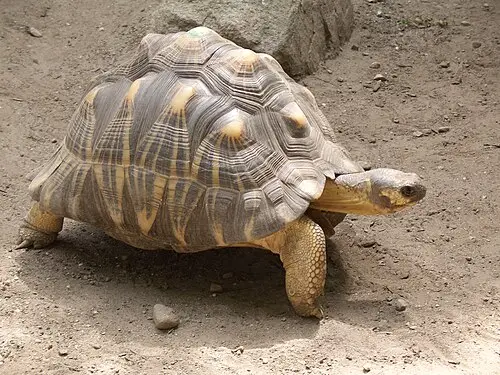
 📸 Photo
Photo: Kyle Bedell · CC BY 2.0 · Wikimedia Commons Source
Radiated Tortoise
Astrochelys radiata (Radiated Tortoise · ホウシャガメ)
💡 Everyday Comparisons for Size, Mass & Speed
- 💡 Its carapace length of about 41 cm is about 1.4 times the long side of an A4 sheet of paper (about 30 cm), and its maximum weight of about 16 kg is about 4/5 of a 20 kg bag of rice (Comparison).
- 💡 In captivity, it also eats everyday table vegetables and fruits such as sweet potatoes, carrots, apples, bananas, and melons (ADW diet description).
Reference standards: coach bus ~12 m, mid-size car ~4.9 m, compact car ~1 t, basketball hoop 3.05 m, credit card 8.56 cm.
Site-computed relative index from recorded values; not a formal scientific metric.
📖 1. Overview
The Radiated Tortoise is a land tortoise living in dry scrub and thorn forests of southern Madagascar, regarded as one of the most beautiful tortoises in the world. Its IUCN status is Critically Endangered (CR, as of 2008).
🦴 2. Anatomy & Morphology
On its high-domed carapace, yellow lines radiate from the center of each dark plate to form a star pattern. Its head and legs are yellow with a black patch on top of the head, and it has thick, elephant-like feet.
🔍 3. Ecology & Behavior
It is a diurnal herbivore feeding on grasses, fruits, and succulents, and in the wild it favors Opuntia cacti. By grazing repeatedly in the same area it keeps vegetation closely trimmed, and females lay 3–12 eggs in a dug hole with a long incubation period.
🇰🇷 4. Connection to Korea
No direct record connecting this species to Korea has been found.
📚 Sources & References
- • IUCN Red List CR (2008) — https://www.iucnredlist.org/species/9014/12950491
- • IUCN Red List category CR — latest assessment at iucnredlist.org
- • catalogueoflife.org — J439
- • iucnredlist.org — 12950491
- • wikidata.org — Q630954
- • commons.wikimedia.org — File:Astrochelys radiata -Roger Williams Park Zoo, USA-8a.jp
- • animaldiversity.org — Astrochelys radiata
- • Silhouette: PhyloPic — Christoph Schomburg · CC0 1.0 (Related taxon silhouette — Gopherus)
Recorded dimensions are widely cited representative estimates from public literature and may vary by study or specimen.