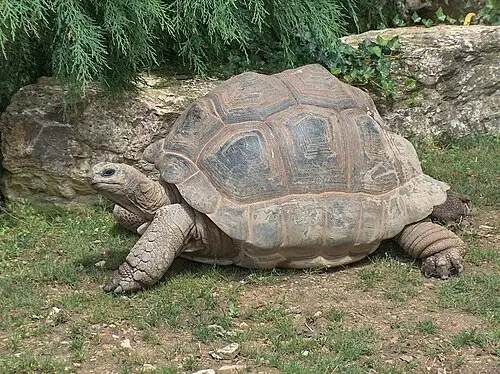
 📸 Photo
Photo: Yotcmdr · Public domain · Wikimedia Commons Source
Aldabra Giant Tortoise
Aldabrachelys gigantea (Aldabra Giant Tortoise · アルダブラゾウガメ)
Not Evaluated (NE) on the IUCN Red List yet.
💡 Everyday Comparisons for Size, Mass & Speed
- 💡 A male's carapace length of 1.22 m is about 1/4 the length of a passenger car (about 4.5 m), and its maximum weight of 250 kg equals twelve and a half 20 kg bags of rice (Comparison).
- 💡 At the Smithsonian National Zoo, they are fed salad greens and hay, allowed to graze outdoors in summer, and given carrots and sweet potatoes as treats (Smithsonian National Zoo).
- 💡 The Aldabra Giant Tortoises at that zoo arrived as adults in 1956 and 1976 and are now estimated to be around 80 years old (Smithsonian National Zoo).
Reference standards: coach bus ~12 m, mid-size car ~4.9 m, compact car ~1 t, basketball hoop 3.05 m, credit card 8.56 cm.
Site-computed relative index from recorded values; not a formal scientific metric.
📖 1. Overview
The Aldabra Giant Tortoise is one of the largest land tortoises in the world, native to Aldabra Atoll in the Seychelles in the Indian Ocean. It is known to live for more than 100 years.
🦴 2. Anatomy & Morphology
Males are much larger than females and have longer, thicker tails. Its thick, elephant-like legs are covered in heavy scales, and its head is small and pointed.
🔍 3. Ecology & Behavior
It grazes mainly on grasses and tree leaves, though it will also eat meat when available, and can push over small trees to reach leaves, playing an elephant-like ecological role on its island. During the February–May breeding season, it lays 9–25 eggs per clutch.
🇰🇷 4. Connection to Korea
No direct record connecting this species to Korea has been found.
📚 Sources & References
- • IUCN Red List: not evaluated (NE) — cross-checked with the Wikidata conservation-status entry
- • catalogueoflife.org — 6689N
- • wikidata.org — Q27885022
- • commons.wikimedia.org — File:Giant Tortoise.JPG
- • nationalzoo.si.edu — aldabra-tortoise
- • Silhouette: PhyloPic — Yotcmdr · Public Domain Mark 1.0
Recorded dimensions are widely cited representative estimates from public literature and may vary by study or specimen.